
Halves or Halfs — do you ever pause and wonder which one is right? You’re not alone. This is one of the most common spelling mix-ups in English. Here’s the short answer to Halves or Halfs. Halves is correct. Halfs doesn’t exist in any dictionary. It never has. The reason comes down to a simple rule. When half becomes plural, the F changes to V.
Then you add “es.” That’s how you get halves. Other words follow this same pattern too. Leaf becomes leaves. Knife becomes knives. Wolf becomes wolves. Once you see the pattern, it clicks fast. This mistake happens because half ends in F. People assume they just add an S. But English has its own rules here. So next time you ask yourself Halves or Halfs, you’ll already know the answer.
What Does “Halves” Mean?
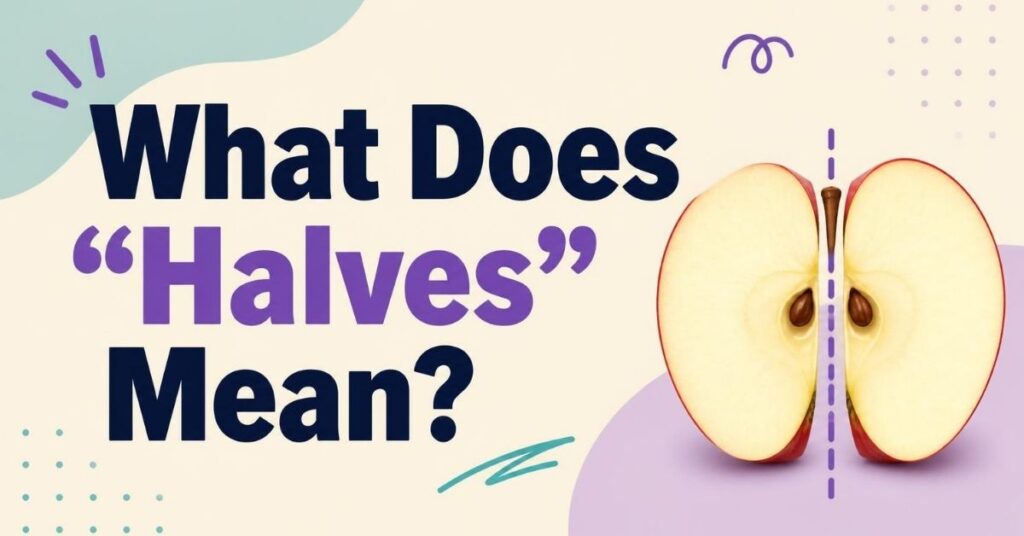
“Halves” is the plural noun form of half.
It describes two equal parts of something that’s been split down the middle.
Think of an orange cut clean in two, or a pizza shared between friends.
It also shows up as a verb form.
“She halves the recipe” means she cuts the amount in two.
Same spelling, different grammatical roles, depending on the sentence.
You’ll hear it everywhere, from sports to cooking to everyday chats.
“Both halves of the game were close.”
“Split the bill into two halves.”
That’s the word doing its job, quietly and correctly.
What About “Halfs”?

Here’s the truth: “halfs” is a spelling error, plain and simple.
It’s not slang, it’s not informal, it’s just wrong.
People type it because “half” ends in F, and adding S feels natural.
But English doesn’t play fair with irregular plural nouns.
Some words just don’t follow the straightforward add-an-S pattern.
Half is one of them, and it insists on “halves” instead.
If you search “is halfs a word,” the answer stays the same everywhere you look.
Merriam-Webster doesn’t list it.
Neither does the Oxford English Dictionary or Cambridge Dictionary.
So skip it, even in casual writing.
The Origin of Halves
English spelling often traces back to Old English roots.
Half comes from the Old English word “healf,” meaning “part” or “side.”
Over centuries, the language shifted how it handled certain word endings.
This is where phonetic history comes into play.
Old English speakers often voiced the F sound when a word became plural.
That voiced sound eventually got written down as V, and the pattern stuck.
So “halves” isn’t some random exception.
It’s a leftover from how the spoken language actually sounded centuries ago.
Spelling rules aren’t always logical, but they usually have a story behind them.
The Grammar Rule: F → VES Plurals
This is the heart of the whole issue: the F → VES rule.
Certain nouns ending in F or FE swap that ending for VES in the plural.
It’s one of the more famous irregular plural pattern rules in English.
Here’s the pattern laid out clean:
- half → halves
- leaf → leaves
- knife → knives
- wolf → wolves
- loaf → loaves
- calf → calves
- shelf → shelves
- wife → wives
Notice something? The f changes to v, then you add -es.
So it’s -f to -ves or -fe to -ves, depending on the original word.
Not every F-ending word follows this, but half definitely does.
This kind of plural transformation trips up even confident writers.
Roof, for example, just takes an S: roofs, not “rooves” (though older texts sometimes use it).
That’s why memorizing the common ones, like half, saves you from guesswork.
Read More: Skied or Skiied? The Correct Spelling in 2026
British English vs. American English Spelling
Good news here: this one’s not a regional argument.
Both British English and American English agree that “halves” is correct.
Australian English and Canadian English follow the same rule too.
Unlike words such as “color” versus “colour,” there’s no split here.
No regional variation, no alternate accepted spelling, no exceptions by country.
Every major English variety treats “halfs” as a straightforward mistake.
So whether you’re writing for a UK audience or a US one, the rule doesn’t change.
That consistency makes this an easy one to lock in permanently.
One spelling, one rule, everywhere English is spoken.
Comparison Table: Half vs. Halves vs. Halve
| Word | Part of Speech | Example |
| Half | Singular noun / adjective | “I’ll have half a sandwich.” |
| Halves | Plural noun | “Cut the apple into halves.” |
| Halve | Verb (present tense) | “Halve the recipe for two people.” |
| Halved | Verb (past tense) | “She halved the cost.” |
| Halving | Present participle | “He’s halving the pizza right now.” |
Each form serves a different grammatical job.
Half works alone or describes something (“half a cup”).
Halves is what you get once there’s more than one part.
Halve, halved, and halving are all about the action of splitting something.
Mixing these up is common, especially for English learners.
But once you see them mapped out like this, the confusion usually clears up fast.
Which Spelling Should You Use?
Simple answer: always use halves for the plural noun.
There’s no context, formal or informal, where “halfs” becomes acceptable.
Not in texts, not in essays, not in professional emails.
If you’re checking your work, Grammarly and Microsoft Word will both flag “halfs” instantly.
That’s a strong signal you’re dealing with a recognized English word versus one that isn’t.
Trust the correction, don’t override it.
For formal writing, this matters even more.
A resume, a report, or an academic paper can lose credibility over small errors like this.
Even in informal writing, like texts to friends, “halves” just reads better and avoids confusion.
Common Mistakes with Halves / Halfs
Let’s go through the slip-ups people actually make.
- Halfs instead of halves — the most frequent mistake by far.
- Half’s used as a plural — that apostrophe signals possessive, not plural, like “the dog’s toy.”
- Halves’ used incorrectly — this is plural possessive, meaning something belonging to the halves.
- Confusing halve and half — halve is the verb, half is the noun/adjective.
- Overcorrecting to “halfes” — another invented spelling that doesn’t exist anywhere.
A quick trick: if you mean “more than one part,” it’s halves.
If you’re talking about cutting something, it’s halve, halved, or halving depending on tense.
If it’s singular, one part, it’s half.
Keep that mental checklist handy and these mistakes mostly disappear.
Read More: Salvadoran or Salvadorian: What Most Get Wrong 2026
Halves in Everyday Examples
Words stick better with real examples, so here are some natural ones.
- “Two halves equal one whole” — the classic phrase everyone learns early.
- “Divide the cake into halves before the guests arrive.”
- “Both halves of the football match were exciting.”
- “She split the orange into halves for the kids.”
- “The team played two strong halves back to back.”
You’ll notice halves shows up across sports, cooking, math, and casual talk.
“Halves of a pizza,” “halves of a sandwich,” “halves of a team” — same word, different settings.
That range is exactly why getting the spelling right matters; it appears more often than you’d think.
Halves – Google Trends & Usage Data
Search behavior backs up everything covered so far.
Queries like “halves or halfs which is correct” and “is halfs a word” show up regularly, which tells you people genuinely get stuck here.
Meanwhile, searches for “halves vs halfs” and “why is half plural halves” reflect real curiosity, not just typos.
Google Trends data consistently shows “halves” dominating as the standard search term.
“Halfs” appears mostly in comparison searches, where people are actively trying to confirm which spelling is right.
That pattern matches what dictionaries and grammar resources already confirm.
This kind of search intent matters for anyone writing content around English grammar topics.
People aren’t just curious, they want a clear, direct answer, fast.
Read More: Kindergarten or Kindergarden: Correct Spelling Guide 2026
Keyword Comparison Table
| Search Term | Correct Answer |
| Halves or halfs | Halves |
| Is halfs a word | No |
| Is halves correct | Yes |
| Plural of half | Halves |
| Half plural spelling | Halves |
| Halfs spelling mistake | Yes, it’s incorrect |
| Correct plural of half | Halves |
Nouns That Follow the Same F → VES Pattern
Half isn’t alone in this English plural rules category.
Several everyday nouns follow the exact same transformation, which makes the rule easier to remember once you group them together.
Leaf becomes leaves, knife becomes knives, and life becomes lives.
Wolf becomes wolves, loaf becomes loaves, and thief becomes thieves.
Once you notice the pattern across several words, half stops feeling like a random exception.
Learning these together, instead of one at a time, helps native speakers and English learners alike.
It turns a confusing spelling rule into a recognizable group you can lean on.
Frequently Confused Word Pairs Like This One
Half and halves aren’t the only pair that causes hesitation.
English is full of singular and plural forms that don’t follow the obvious pattern, and that’s part of what makes the language tricky for so many learners.
Words like child/children, foot/feet, and tooth/teeth work the same way half does.
None of them just add an S, and all of them require a bit of memorization.
The good news is that once you’ve learned a handful of these irregular patterns, spotting new ones gets easier.
Your brain starts recognizing the shape of the rule, even before you’ve memorized the specific word.
FAQ’s
Is halves or halfs the correct spelling?
Halves is correct. Halfs is not a real word in English.
Why is half spelled halves in plural form?
Half follows the F to V rule. The F changes to V, then you add es.
Is halfs ever acceptable in casual writing?
No. Halfs is always wrong, even in texts or informal writing.
What is the plural of half?
The plural of half is halves. There is no other correct form.
Does British English spell it differently than American English?
No. Both British and American English use halves as the correct plural.
Can halves be used as a verb?
No. Halve is the verb. Halves is the plural noun form.
Conclusion
So, Halves or Halfs — now you know the answer. Halves is correct. Halfs is not a word. It never has been. The rule is simple once you see it. Half changes to halves because of the F to V pattern. This happens with other words too, like leaf and knife. So when people ask “Halves or Halfs,” the answer stays the same every time. Halves wins, always.
This mix-up trips up a lot of people. But now you know the fix. Next time you’re not sure about Halves or Halfs, just remember this rule. Halves means more than one part. Halfs simply doesn’t exist. Whether you’re writing an email, a text, or an essay, get it right. Halves or Halfs isn’t a hard question anymore. You’ve got the answer, and it’s here to stay.

James Carter is an English grammar writer and contributor at GoldenMegazine.com, where he shares clear, practical, and easy-to-understand guidance on grammar, vocabulary, sentence structure, and everyday English usage. His goal is to make complex language concepts simpler for students, writers, and English learners while helping readers communicate more confidently and effectively.
