
Congratulations or Congradulations? The correct spelling is congratulations, with a T and no D. Many people mix this up because the word sounds like it has a D. It doesn’t. One wrong letter can spoil a warm message on a card, text, or banner. It happens to everyone, even careful typists. Spell-checkers don’t always catch it. That’s why Congratulations or Congradulations confuses so many writers.
This guide clears up Congratulations or Congradulations in simple steps. You’ll learn where the word comes from and why people misspell it. You’ll also get easy tricks to remember it. We’ll share examples for emails, cards, and social posts. Each tip is short and easy to follow. You can use them today. Whether you’re writing to a friend or a boss, the right spelling shows you care. Let’s fix this mistake for good. Read on.
Congratulations or Congradulations – Quick Answer
The correct spelling of congratulations has two Ts and no Ds.
Spell it c-o-n-g-r-a-t-u-l-a-t-i-o-n-s, and you’re done.
Congradulations is a common spelling mistake, not a regional variant.
Merriam-Webster and every other standard English reference list only the T form.
Here’s a trick for the next time you’re typing in a hurry.
Look for the GRAT root in the middle, the same one inside grateful and gratitude.
No D hides in that family.
Examples:
Seeing both versions side by side makes the error obvious.
Here are a few sentences, right and wrong.
• Correct: Congratulations on your new job, Maria!
• Wrong: Congradulations on your new job, Maria!
• Correct: Congratulations on your achievement, and thank you for your hard work.
• Wrong: Congradulations on your achievement.
• Correct: Sending warmest congratulations on your wedding.
Notice that the wrong versions look almost fine at a glance.
That’s why this slip survives in so many cards and texts.
The Origin of Congratulations or Congradulations
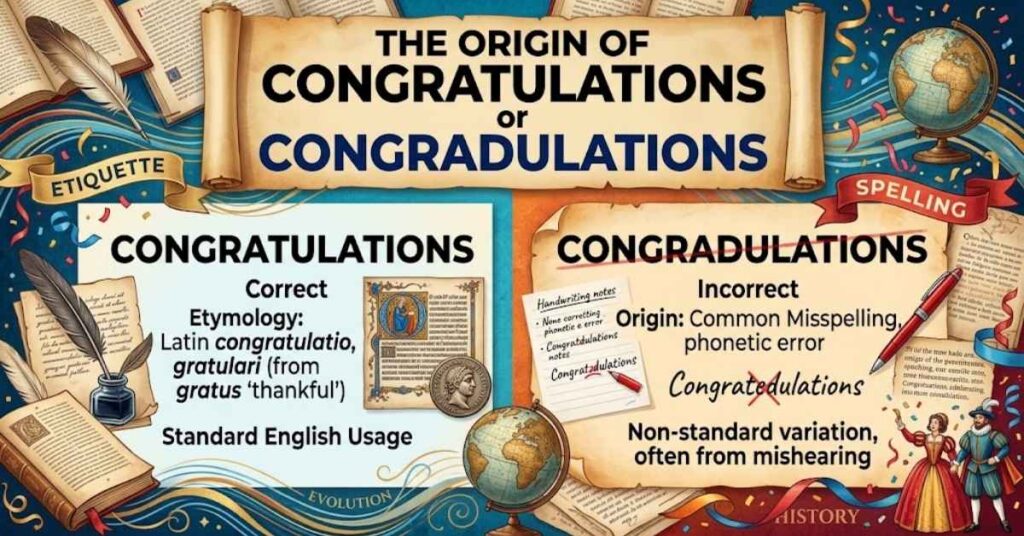
The word comes from the Latin verb congratulari.
It blends com, meaning together, with gratulari, meaning to show joy.
That second piece grows out of gratus, the Latin word for pleasing.
You’ll find the same family in grateful and gratitude.
English picked up the verb in the 1500s, and the noun grew from it.
The Online Etymology Dictionary traces this Latin origin of congratulations in more detail.
Read More: Customize or Customise? Spelling Trap Most People Miss 2026
Why does “congradulations” exist?
Blame your ears, not your brain.
In quick speech, the T in “grat” softens into a “ch” sound, and some people hear a D or a J.
The word has five syllables: con-grat-u-la-tions.
The syllable stress lands on “la”, so the earlier T gets tucked away and sounds weak.
The word “graduation” adds to the confusion.
Many people link congratulations with grads, so a D sneaks in by association.
That’s letter substitution at work, a classic case of pronunciation confusion.
British English vs American English Spelling
Here’s the good news: there’s no split on this one.
British English and American English spell it the same way.
You won’t face a colour versus color situation.
Whichever side of the Atlantic you write for, two Ts and no D is the rule.
Comparison Table
| Feature | British English | American English |
| Main spelling | congratulations | congratulations |
| Short form | congrats | congrats |
| Verb | congratulate | congratulate |
| Adjective | congratulatory | congratulatory |
| Formal option | felicitations | felicitations |
| Common error | congradulations | congradulations |
Which Spelling Should You Use?
Use congratulations in every situation.
The D version never earns a pass, not even in casual texts.
What changes is the tone, not the spelling.
A close friend gets “congrats”, while your manager gets the full word.
Based on your audience:
Pick the form that fits who’s reading.
• Friends and family: congrats or congratulations, both work fine.
• Coworkers: congratulations, ideally with a personal line about what they did.
• Clients and executives: the full word, or “please accept my congratulations”.
• Teachers and academic readers: congratulations, written out in full.
• Social media: congrats or congratulations, plus emojis if it suits you.
When you’re unsure, go with the full word.
It’s never wrong, and it never looks careless.
Common Mistakes with Congratulations or Congradulations
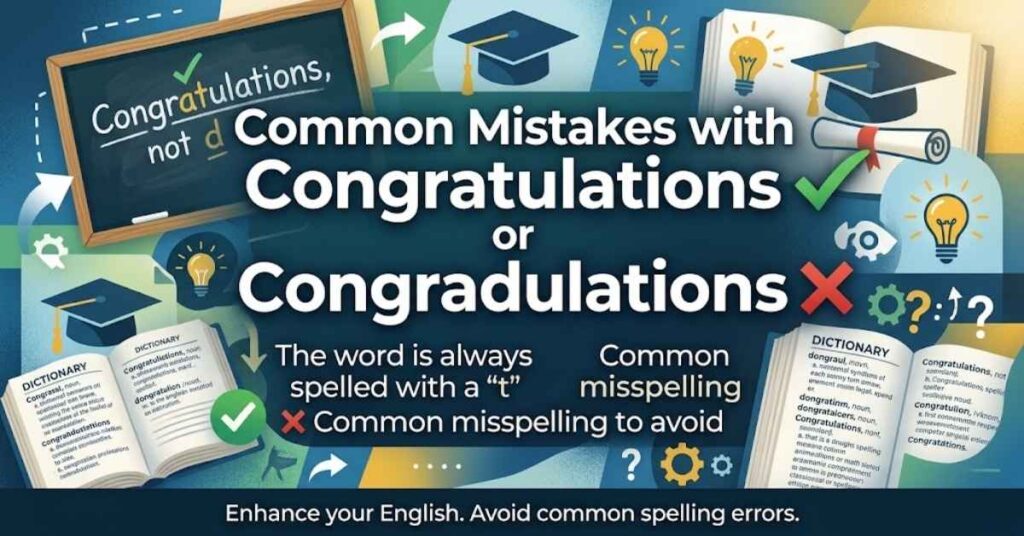
Most errors fall into a few predictable buckets.
Knowing them helps you catch a slip before you hit send.
Spell-checkers in Microsoft Word and Google Docs usually flag the misspelling with a red line.
Still, phones and quick chats don’t always catch it.
Common Mistakes
• Congradulations (a D in place of the T).
• Congratulation on your win (the exclamation needs the plural).
• Congrajulations or congradulashuns (spelled how it sounds).
• Congratulations for your promotion (the usual preposition is “on”).
• Congradulate (the verb with the same D slip).
Correct Forms
• Congratulations on your promotion.
• I’d like to congratulate you on passing the exam.
• Please accept my congratulations.
• She sent a warm congratulatory email.
Quick note on the preposition.
You congratulate someone on success, and you rarely congratulate them for it.
Congratulations or Congradulations in Everyday Examples
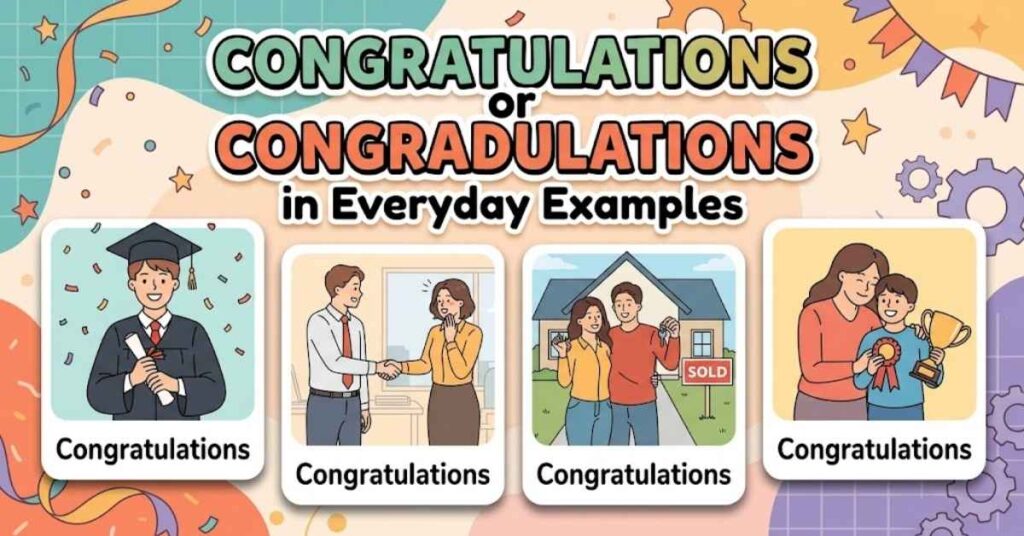
Seeing the word in real settings helps it stick.
Here’s how it looks across four common places.
Emails
In a professional email, put it right in the subject line.
Example: Congratulations on your promotion, Priya.
Open the body with warm words, then add one specific detail.
That small touch beats a generic “well done” every time.
News Headlines
Editors love the word because it’s short and upbeat.
A headline like “Congratulations pour in after local team wins title” is typical.
Newsrooms run strict style checks, so the D form rarely survives to print.
That’s a good sign you’re looking at the standard English spelling.
Social Media
On social media captions, people shorten it to congrats.
Example: Congrats, Sam! You earned every bit of this.
That’s fine for casual posts.
Just skip “congrads” on a brand page, unless it’s a deliberate graduation pun.
Formal Writing
In academic writing or official announcements, write the full word.
Example: Please accept my sincere congratulations on your appointment as department head.
Pair it with words like heartfelt or sincere for extra warmth.
Skip the abbreviations and keep the sentence clean.
Congratulations Messages for Popular Occasions
Spelling is half the job, and the message is the other half.
These short lines suit common happy occasions.
• Congratulations on your new job: Congratulations on the new role! They’re lucky to have you.
• Congratulations on graduation: Congratulations, graduate! All those late nights paid off.
• Congratulations on passing an exam: You did it! Your hard work really showed.
• Congratulations on your promotion: Congratulations on the promotion. You earned it.
• Congratulations on your wedding: Heartfelt congratulations to you both.
Swap in names and specifics to make each line yours.
A real detail turns a congratulatory message into something people save.
Synonyms and Alternatives for Congratulations
Sometimes you want a different word.
Congratulations synonyms keep a long card from sounding repetitive.
• Well done: casual and warm.
• Kudos: informal praise, great for work chat.
• Bravo: playful and a bit theatrical.
• Hats off to you: a friendly idiom.
• Felicitations: formal and polished.
The felicitations meaning is simple: good wishes for someone’s happy news.
It ties back to the Latin felicitas, meaning happiness.
Use synonyms sparingly, though.
Congratulations remains the clearest and most recognized choice, so lead with it and let the others support it.
How to Remember the Correct Spelling
A few small tricks beat rote memory.
Try these next time your fingers hesitate.
• Say it in chunks: con-grat-u-la-tions, with a T in “grat” and another in “tions”.
• Link it to gratitude, since both share the GRAT root.
• Count the Ts: two in total, and none turn into a D.
• Type it slowly three times, then trust the habit.
• Let the red squiggle teach you, then fix it on the spot.
Picture a new hire sending “Congradulations!” to the whole team.
Nobody says a word, but everybody notices.
Read More: Bellies or Bellys? The Spelling Most People Miss in 2026
Why Spelling Matters in Professional Communication
A single wrong letter can shift how people read your message.
Readers rarely say it out loud, but they do notice.
Imagine sending a note about a job promotion to a senior leader.
If the first word is misspelled, the warm tone gets lost.
Careful spelling signals care.
In professional communication, that small signal builds trust.
It also makes celebrating achievements feel genuine instead of rushed.
Congratulations or Congradulations – Google Trends & Usage Data

Search data tells a clear story about this word.
People look up the correct term far more often than the misspelling.
You can test it yourself by typing both terms into Google Trends.
The search volume gap is usually huge.
Key Insights:
• The correct spelling dominates search volume in almost every region.
• Interest climbs around graduation season and the wedding months.
• Many searches for the misspelling likely come from people double-checking before they post.
• Searches for congrats stay steady thanks to texts and social posts.
Treat these as patterns to confirm on a fresh chart.
Trends shift, so check again before you quote them.
Comparison Table: Keyword Variations
| Term | Correct? | Notes |
| congratulations | Yes | Standard plural form, right for every context |
| congradulations | No | Common misspelling, avoid it |
| congratulation | Rarely | Singular noun, seldom used alone |
| congrats | Yes | Informal short form |
| congrads | Informal only | Playful, mostly graduation puns |
| congratulate | Yes | The verb form |
| congratulatory | Yes | Adjective, as in a congratulatory note |
| felicitations | Yes | Formal and a little old-fashioned |
Frequently Asked Questions
Is “congradulations” ever correct?
No. It’s a misspelling in every dictionary and style guide.
The only exception is deliberate wordplay on a graduation card, and that’s a joke, not a spelling.
What is the correct spelling of congratulations?
It’s congratulations, with two Ts and no D.
Remember the full run: c-o-n-g-r-a-t-u-l-a-t-i-o-n-s.
Does British English spell it differently from American English?
No. Both varieties spell it congratulations.
Any difference shows up only in accent.
What does “congratulations” mean?
It expresses joy or praise for someone’s success or good luck.
You can use it for a promotion, a wedding, or a new baby.
What is the verb form of congratulations?
The verb is congratulate.
For example: I’d like to congratulate you on your win.
Can I use “congrats” in professional writing?
In casual workplace chat, yes.
In formal emails, letters, or announcements, write the full word.
Why do people write “congradulations” instead of “congratulations”?
Mostly because of pronunciation.
The T sounds soft, and the link to “graduation” adds confusion.
How do you pronounce congratulations?
Say it as kuhn-grach-uh-LAY-shunz.
Put the stress on the fourth syllable, “LAY”.
Conclusion
So, Congratulations or Congradulations? The answer is simple. Congratulations is the only correct spelling. It has a T, never a D. Congradulations is just a common mistake. It comes from how we say the word. Remember the GRAT root, like in grateful and gratitude. That tiny clue keeps your spelling safe. Next time you wonder about Congratulations or Congradulations, pick the T. You’ll be right every time.
Now you know why Congratulations or Congradulations trips so many people up. You’ve seen the origin, the common mistakes, and real examples. You also have quick tricks for Congratulations or Congradulations. Use the full word in formal emails. Use congrats with friends. Always skip the D. It’s easy. Did this guide help with Congratulations or Congradulations? Share it with someone who needs it. Drop your questions in the comments. Keep writing with confidence.

James Carter is an English grammar writer and contributor at GoldenMegazine.com, where he shares clear, practical, and easy-to-understand guidance on grammar, vocabulary, sentence structure, and everyday English usage. His goal is to make complex language concepts simpler for students, writers, and English learners while helping readers communicate more confidently and effectively.
