
Lieing or Lying is a common spelling question that confuses many English writers. The correct spelling is lying, not lieing. It can mean resting in a horizontal position or telling someone something untrue. Knowing the right spelling helps you avoid mistakes in emails, schoolwork, and everyday messages. Although both forms may look correct at first, standard English accepts only one. The spelling rule is simple once you understand how the verb changes.
Why do people write lieing instead of lying? The confusion comes from adding -ing to verbs that end in -ie. In this case, the ie changes to y before adding the ending. This rule turns lie into lying. Learning Lieing or Lying helps you recognize the same pattern in words like dying. In this guide, you will find clear definitions, grammar rules, common mistakes, and examples to help you use Lieing or Lying correctly.
Lieing or Lying: Quick Answer
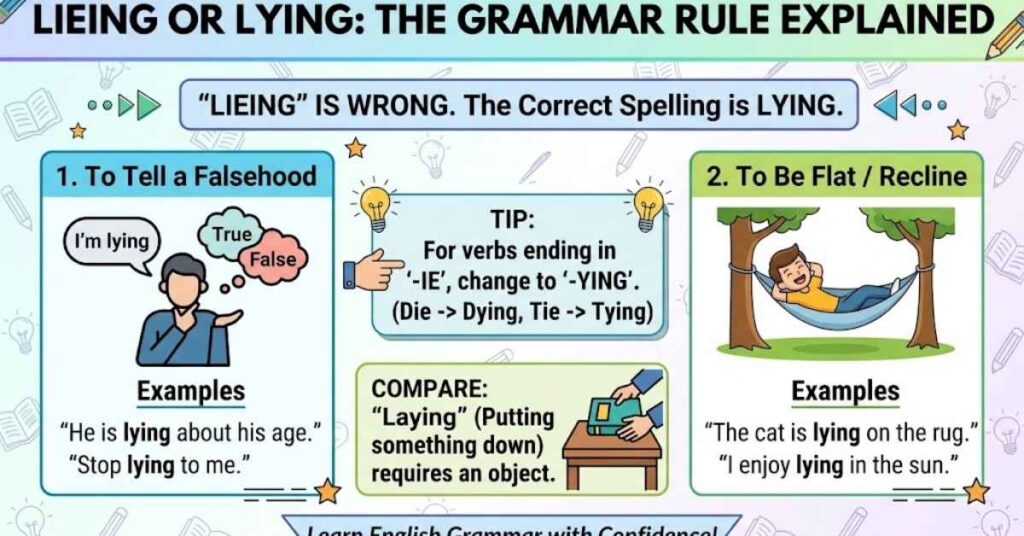
Lying is correct, while lieing is incorrect in standard English. The base verb lie changes its spelling to lying when you add the -ing ending. The final ie becomes y, so you don’t keep the original vowel combination.
Here are a few examples:
- Correct: She is lying on the couch.
- Correct: He is lying about what happened.
- Incorrect: She is lieing on the couch.
- Incorrect: He is lieing about what happened.
The same spelling applies in American English, British English, and Australian English. There isn’t a regional spelling difference here.
If you’re unsure how to spell the word, remember this simple pattern: lie becomes lying. Once you recognize the -ie to -y rule, the correct form becomes much easier to remember.
What Is “Lieing”?
Lieing is a common incorrect spelling of lying. People often write it because they apply the usual process of adding -ing to a verb without checking whether the spelling needs to change.
For example, writers might assume that lie becomes lieing, just as play becomes playing. However, English verbs don’t all follow the same spelling pattern. Some require a change before the ending is added.
In standard English, lieing isn’t the accepted present participle or gerund form of lie. Dictionaries such as Merriam-Webster and Cambridge use lying for the relevant verb forms.
You might still encounter lieing in online posts, informal messages, or writing that hasn’t been proofread. Its appearance doesn’t make it the correct spelling. If you’re preparing an assignment, report, application, or professional email, use lying.
What Is “Lying”?
Lying is the correct spelling of the -ing form of the verb lie. Its meaning depends on the sentence. It can describe someone’s physical position or the act of saying something untrue.
Consider these examples:
- “The dog is lying beside the door.”
- “She is lying about her age.”
- “I spent the afternoon lying on the sofa.”
In the first and third examples, lying describes a resting or reclining position. In the second, it describes dishonesty. The spelling remains the same, even though the meanings differ.
Grammatically, lying can function as a present participle or a gerund. A present participle helps form continuous verb tenses, as in “He is lying.” A gerund functions as a noun, as in “Lying can damage trust.”
Meaning 1: To Be in a Horizontal or Resting Position
The verb lie can describe a person or object resting in a particular position. It often refers to someone reclining on a bed, couch, floor, or another surface.
For example, “My cat is lying on the bed” describes the cat’s position. Similarly, “She was lying under a tree” tells you where she was resting.
In these sentences, lying down doesn’t suggest dishonesty. The surrounding words make the intended meaning clear. This distinction matters because the same verb can describe a physical position or an untruth.
Meaning 2: To Tell an Untruth
The second meaning of lying involves dishonesty, deception, or making a false statement. Someone is lying when they deliberately say something they believe isn’t true.
For example, “He is lying about where he went last night” suggests that he isn’t telling the truth. Another example is, “She admitted to lying on her application.”
The word often appears with phrases such as lying to someone, lying about something, and lying in court. It can also describe dishonest claims on a résumé. In these contexts, lying concerns the truthfulness of someone’s statement, not their physical position.
Lieing or Lying: The Grammar Rule Explained
| Base verb | Correct -ing form | Incorrect form |
| Lie | Lying | Lieing |
| Die | Dying | Dieing |
| Tie | Tying | Tieing |
| Vie | Vying | Vieing |
The -IE to -Y Rule
The -ie to -y rule explains why verbs ending in -ie usually change those letters to y before taking the -ing ending. Instead of writing lieing, you write lying. The same pattern gives you dying, tying, and vying.
Think of the transformation as a simple spelling adjustment:
- Lie + ing = lying
- Die + ing = dying
- Tie + ing = tying
- Vie + ing = vying
However, don’t confuse this pattern with every verb that ends in e. Many verbs simply drop the final e before adding -ing. For example, make becomes making, and write becomes writing.
The key is to recognize the ending of the base verb. Verbs ending in -ie follow a different spelling pattern from many verbs ending in a single e. Understanding that difference will improve your writing accuracy and reduce common spelling errors.
The Origin of Lieing or Lying

The spelling of lying reflects the historical development of English spelling and word formation. English has borrowed words from different languages and developed conventions over centuries. As a result, its spelling rules don’t always match the way words sound.
The verb lie has Old English roots. Its history is connected to the meaning of resting or occupying a position. The verb meaning to tell an untruth has a different historical background, although both verbs share the same modern spelling.
The modern form lying follows the established spelling convention for verbs ending in -ie. When the -ing ending is added, the final letters change to y. This convention helps explain the form used in present-day dictionaries and standard written English.
You don’t need to memorize the word’s entire history to spell it correctly. The practical lesson is that English morphology, or the way words change form, sometimes requires more than attaching an ending to the base word.
British English vs American English Spelling
Is lying spelled differently in British and American English? No. The correct spelling is lying in both varieties, and the same form is standard in Australian English.
Some English words have regional spelling differences. For example, American English commonly uses color, while British English uses colour. Similarly, organize and organise appear in different regional conventions.
However, those differences don’t apply to lying. Writing lieing isn’t an accepted British alternative or an American spelling variation. It’s a spelling error in standard usage.
Whether you’re writing a university assignment in Australia, a work email in the United States, or a report in the United Kingdom, use lying. You won’t need to change the spelling to match your audience’s regional variety of English.
Which Spelling Should You Use?
Always use lying when you need the -ing form of lie. This applies whether you’re describing someone resting or someone telling an untruth. The context changes the meaning, but the spelling stays the same.
If you’re writing something important, check the sentence rather than relying on how the word looks. For example, “The child is lying on the floor” describes a position. “The child is lying to the teacher” describes dishonesty.
You can also use a spelling checker to catch mistakes. Tools such as Grammarly, Google Docs, and Microsoft Word may flag lieing and suggest lying. Still, automatic suggestions aren’t a substitute for understanding the rule.
For clear formal writing, remember these three points:
- Use lying for the present participle and gerund.
- Use lied for the past tense of lie when it means telling an untruth.
- Use lay and lain carefully when discussing the physical-position meaning of lie.
The last point is especially important because lie and lay are commonly confused. Their verb forms follow different patterns, which can affect the meaning of your sentence.
Common Mistakes with Lieing or Lying

The confusion doesn’t stop with the spelling of lying. Many writers also mix up lying, laying, lied, and lain. These words are related through their use in English sentences, but they don’t all mean the same thing.
The easiest way to avoid these common spelling mistakes is to look at the action being described. Is someone resting? Telling an untruth? Or placing something somewhere? Answering that question helps you select the correct verb form.
Mistake 1: Confusing “Lying” with “Laying”
Lying and laying are different verb forms. Lying usually describes resting or telling an untruth, while laying means putting or placing something somewhere.
The main grammatical difference is that lay normally takes a direct object. You lay something down, but you lie down yourself.
Compare these examples:
- Correct: “I’m lying on the bed.”
- Correct: “I’m laying the blanket on the bed.”
- Incorrect for the intended meaning: “I’m laying on the bed.”
In the second sentence, the blanket is the direct object. In the first, the speaker simply describes their own position. Remembering this distinction makes lie vs lay grammar much easier to understand.
Mistake 2: Getting the Past Tense Wrong
Another common error involves choosing the wrong past tense. When lie means telling an untruth, its past tense is lied. When lie describes resting or reclining, its past tense is lay.
The past participle also differs. For the dishonesty meaning, use lied. For the physical-position meaning, use lain, usually with a helping verb such as has or had.
Here are examples:
- Present: “He is lying about the results.”
- Past, dishonesty: “He lied about the results.”
- Present: “She is lying on the sofa.”
- Past, resting: “She lay on the sofa yesterday.”
- Past participle, resting: “She has lain on the sofa for an hour.”
These forms can feel confusing because two different verbs share the spelling lie. Pay attention to the intended meaning before selecting the past tense or past participle.
Mistake 3: Writing “Dieing” Instead of “Dying”
The spelling mistake dieing follows the same mistaken pattern as lieing. Writers may assume they should preserve the final ie when adding -ing. However, the correct form is dying.
For example, “The plant is dying because it hasn’t received enough water” is correct. Writing “The plant is dieing” is incorrect in standard English.
This example helps reinforce the -ie to -y rule. The verbs lie, die, tie, and vie change their final ie to y before taking -ing. Remembering all four forms can help you avoid several common English spelling errors.
Lieing or Lying in Everyday Examples
| Sentence | Meaning |
| The baby is lying in the crib. | Resting in a position |
| I’m lying on the couch after work. | Reclining |
| He is lying to his parents. | Being dishonest |
| She was lying about the missing money. | Making a false statement |
| Lying in the sun makes me sleepy. | Resting in a position |
| Lying about your qualifications can cause problems. | Dishonesty |
| The dog is lying beside its owner. | Resting in a position |
| He admitted to lying during the interview. | Dishonesty |
Why Does “Lie” Become “Lying” Instead of “Lieing”?
The reason is the standard spelling transformation for verbs ending in -ie. English convention changes the final ie to y before adding -ing. This produces a recognizable form that readers and dictionaries consistently use.
If you wrote lieing, you would be applying a different word-formation pattern. That pattern doesn’t fit this verb. The result looks plausible, but it isn’t the standard form.
You can remember the rule by grouping similar words together:
- Lie becomes lying.
- Die becomes dying.
- Tie becomes tying.
- Vie becomes vying.
This approach is more useful than trying to guess how every verb should change. When a spelling seems uncertain, check a trusted dictionary or grammar reference rather than relying on appearance alone.
Lieing or Lying: Google Trends and Usage Data
People searching for lieing or lying usually want a quick spelling answer, a grammar explanation, or examples they can apply immediately. The most useful response should address those needs before discussing the wider language rules.
Google Trends can help compare the relative search interest in lieing and lying. However, Trends reports normalized interest rather than a complete count of searches. Its results can vary by location, date range, and search category.
Without a current, verified Trends comparison, it’s better not to claim a specific search-volume difference or percentage. Likewise, Google Ngram Viewer can show how frequently terms appear in its book corpus, but it doesn’t represent every form of everyday online writing.
For practical writing, the evidence you need is straightforward: lying is the standard spelling recognized by major English dictionaries. The alternative lieing is a common error, not a regional spelling. Checking a dictionary is more useful than guessing based on a search trend.
Comparison Table: Lieing vs Lying
| Feature | Lying | Lieing |
| Standard spelling | Correct | Incorrect |
| Dictionary-approved verb form | Yes | No |
| Present participle of lie | Yes | No |
| Gerund form of lie | Yes | No |
| Meaning: resting horizontally | Yes | No |
| Meaning: telling an untruth | Yes | No |
| Accepted British spelling | Yes | No |
| Accepted American spelling | Yes | No |
| Suitable for formal writing | Yes | No |
How to Check and Correct the Spelling
If you regularly struggle with English spelling, a few simple habits can make proofreading easier. You don’t need to rely entirely on spell-check tools or memorize every rule at once.
Try these steps when you’re uncertain:
- Identify the base verb. Check whether you’re starting with lie, die, or another verb.
- Apply the spelling rule. If the verb ends in -ie, change those letters to y before adding -ing.
- Read the sentence aloud. Confirm that the word communicates the meaning you intend.
- Check a reliable dictionary. Merriam-Webster, Cambridge Dictionary, and Oxford Dictionary are useful references.
- Review automated suggestions. Grammarly, Google Docs, and Microsoft Word can help flag possible spelling errors.
For example, if you write “She is lieing on the couch,” your first step is to identify the base verb lie. Apply the spelling change, and the sentence becomes “She is lying on the couch.”
The same process works when you mean dishonesty. “He is lieing to his friend” becomes “He is lying to his friend.” Once you understand the rule, both corrections are straightforward.
Conclusion
Lieing or Lying is a common spelling mistake, but the correct spelling is lying. The word lieing is incorrect in standard English. You can use lying when someone rests in a flat position or tells something untrue. The rule is simple once you understand it. When a verb ends in -ie, change those letters to y before adding -ing. That is why lie becomes lying. Learning this rule can help you avoid mistakes in your daily writing.
Understanding Lieing or Lying makes English spelling easier. You can use this rule in emails, schoolwork, and everyday messages. Remember that lying is the correct form, while lieing is a misspelling. Practice writing simple sentences to remember the difference. The more you use the correct spelling, the easier it becomes. Keep the Lieing or Lying rule in mind whenever you write. I can also help you create a short FAQ section for this article.
FAQs
Is it lieing or lying?
Lying is correct. The verb lie changes its final ie to y before adding -ing.
Why is lying correct and lieing incorrect?
English spelling conventions change the final ie to y in this verb form. Therefore, lie becomes lying, not lieing.
Is lieing a real English word?
Lieing appears in some informal writing as a spelling error, but it isn’t the standard form of the verb. Use lying instead.
What does lying mean?
Lying can mean resting in a horizontal position or deliberately saying something untrue. The sentence determines which meaning applies.
What is the difference between lying and laying?
Lying describes resting or telling an untruth. Laying means putting something somewhere and usually takes a direct object.
What is the past tense of lie?
When lie means telling an untruth, the past tense is lied. When it means resting, the past tense is lay.
Is it lying or lieing in American English?
Lying is correct in American English. Lieing isn’t an accepted American spelling.
Is it lying or lieing in British English?
Lying is also correct in British English. There is no British spelling variation that makes lieing correct.
What is the rule for verbs ending in -ie?
Change the final ie to y before adding -ing. Examples include lie/lying, die/dying, and tie/tying.
What are some examples of lying in a sentence?
Examples include “The dog is lying on the floor” and “He is lying about the missing money.” The first describes position, while the second describes dishonesty.

James Carter is an English grammar writer and contributor at GoldenMegazine.com, where he shares clear, practical, and easy-to-understand guidance on grammar, vocabulary, sentence structure, and everyday English usage. His goal is to make complex language concepts simpler for students, writers, and English learners while helping readers communicate more confidently and effectively.
