
Feet or Foot which one do you use? It depends on the number.The foot is singular. Feet is plural. One foot, two feet. Simple as that.Most people get this right without thinking. But things get tricky with height and measurements. You might hear “he’s six foot tall” or “he’s six feet tall.” Both sound normal.
So which one is correct?This guide clears up the confusion. You’ll learn when to use foot and when to use feet. We’ll cover body parts, measurements, and common phrases. You’ll also see how British and American English handle this differently.By the end, you won’t hesitate anymore. You’ll know exactly which word fits your sentence. Let’s break it down step by step.
Feet or Foot – Quick Answer
Here’s the short version.
Foot is singular. Feet is plural.
That rule holds whether you’re describing a body part or a unit of measurement.
The tricky part comes with height and distance, where “foot” sometimes acts like an adjective instead of a noun, and that’s where the spelling rules bend a little.
Read More: Skied or Skiied? The Correct Spelling in 2026
Examples
Feet
- She has small feet.
- The kids ran around barefoot, leaving wet feet on the tile.
- It’s ten feet from the door to the wall.
- Snow piled up three feet deep overnight.
Foot
- He broke his foot playing soccer.
- The dog sat at the foot of the bed.
- The ladder is ten foot tall (informal usage).
- Turn left at the foot of the hill.
The Origin of Feet or Foot

The word “foot” traces back to Old English, where it was “fot,” and further back to Proto-Germanic roots.
Its plural form didn’t just tack on an “s” the way regular nouns do. Instead, it went through a process called i-mutation, sometimes called umlaut, where a vowel sound shifts because of a sound that used to follow it.
That’s the same reason English has other irregular plurals like tooth and teeth, goose and geese, man and men, woman and women, and mouse and mice. These pairs feel odd today, but they’re leftovers from a much older stage of the language, back when plural endings actually changed the vowel inside the word rather than adding a letter to the end. Foot and feet are part of that small, stubborn club of words that never got “regularized” over the centuries.
British English vs American English Spelling
Here’s some good news. Feet or foot don’t actually change spelling between British English and American English. Where the two dialects split is usage, not spelling.
In British usage, people are more likely to say “he’s six foot two” in casual conversation, treating “foot” as a fixed unit regardless of the number in front of it. In American usage, especially in formal American English and print, “six feet two” tends to show up more often, following the standard plural rule. Style guides like AP Style and the Chicago Manual of Style both lean toward “feet” in formal writing, while everyday speech on both sides of the Atlantic bends the rules constantly.
Read More: Salvadoran or Salvadorian: What Most Get Wrong 2026
Comparison Table
| Context | British English | American English |
| Casual height | “six foot two” | “six feet two” |
| Formal writing | “six feet two inches” | “six feet two inches” |
| Measurement noun | feet (e.g., “ten feet of rope”) | feet (e.g., “ten feet of rope”) |
| Compound adjective | ten-foot pole | ten-foot pole |
Which Spelling Should You Use?
If you’re writing anything formal, whether that’s a report, an article, or academic writing, stick with “feet” for plural measurements. It’s the standard English choice and the one every major grammar rule points to.
Save “foot” for singular measurements, body parts, and those fixed compound adjective phrases like “five-foot fence” or “ten-foot ceiling,” where the number and “foot” join together before a noun. That last part trips people up constantly, so here’s the pattern to remember.
- Use feet as a standalone measurement noun: “The room is twelve feet wide.”
- Use foot inside a hyphenated compound adjective before a noun: “It’s a twelve-foot room.”
Notice how the same number, twelve, pairs with feet in one sentence and foot in the other. That’s not a typo. It’s the rule doing exactly what it’s supposed to do.
Common Mistakes with Feet or Foot
A few slip ups show up again and again, even among confident writers.
- Writing “foots” or “feets,” both of which are flatly wrong. “Foots” incorrect and “feets” incorrect should be treated as spelling errors, not casual variants.
- Forgetting the hyphenated compound adjective rule, writing “a ten foot ladder” instead of “a ten-foot ladder.”
- Mixing up feet tall with foot wide in the same sentence without noticing the inconsistency.
- Using “foot” for plural distances in formal contexts, like “the fence is 20 foot long” instead of “20 feet long.”
- Overcorrecting casual speech, forcing “six feet two” into dialogue where “six foot two” would sound more natural.
Each of these mistakes comes from the same root cause. Foot and feet aren’t behaving like ordinary nouns, so writers fall back on habits that don’t quite fit the irregular plural noun pattern.
Feet or Foot in Everyday Examples
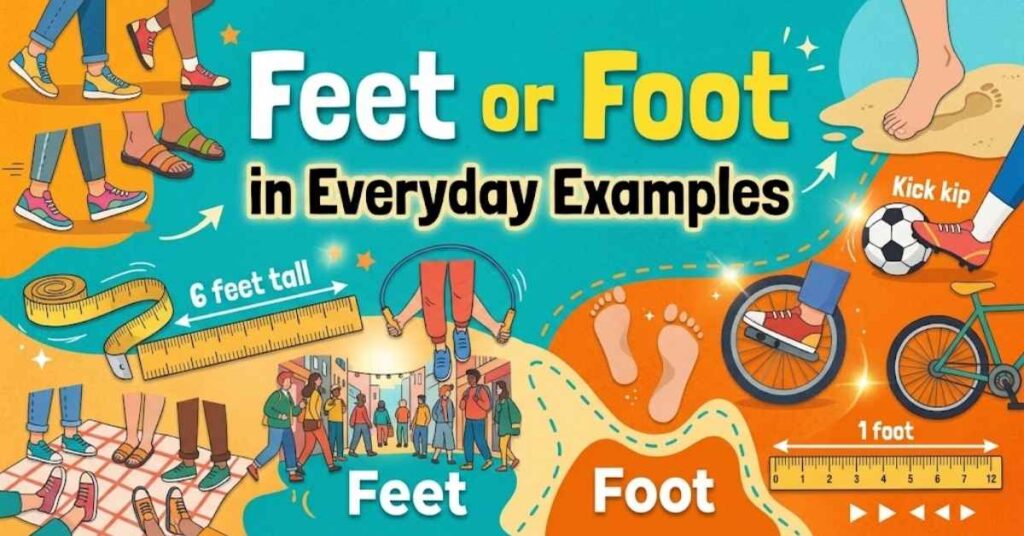
1. Emails
Emails tend to favor whatever sounds natural when read aloud. “The desk is about five feet wide” works fine in a quick note to a colleague.
Keep it simple and skip the second guessing. If the sentence sounds right out loud, it’s almost always grammatically right too.
2. News Writing
News writing leans heavily on AP Style, which prefers “feet” for plural measurements and numerals for figures, like “10 feet” rather than “ten feet.”
Reporters describing storm damage, building heights, or snow totals will almost always default to feet, since precision matters and readers expect consistency across articles.
3. Social Media
Social media is the wild west of grammar, and that’s fine. “Bro is literally 6 foot 5” reads completely normal in a tweet or comment, even though it breaks the formal rule.
Nobody’s grading captions on grammar, so casual phrasing thrives here, and honestly, forcing “6 feet 5” into a meme caption would look stiff.
4. Formal Writing
Formal writing, whether it’s a contract, a scientific paper, or a business report, sticks to the rulebook. “The structure stands 42 feet tall” reads as professional and precise.
Save the casual “42 foot” phrasing for conversation, not documents meant to be taken seriously.
Feet or Foot – Google Trends & Usage Data
Search behavior tells its own story about how people actually write, versus how they’re taught to write. Searches for “feet or foot” and “foot vs feet” spike consistently, which shows this isn’t a rare confusion, it’s one of the most common grammar comparison questions in English.
Interest tends to climb around back to school season, when students and English learners are brushing up on irregular plurals, and again whenever a viral post sparks a debate about “six foot” versus “six feet.” That pattern lines up with how often the phrase shows up in casual writing despite the formal rule favoring “feet.”
Read More: Kindergarten or Kindergarden: Correct Spelling Guide 2026
Comparison Table: Feet or Foot
| Use Case | Correct Form | Example |
| Plural body part | feet | Her feet were tired after the hike. |
| Singular body part | foot | He stubbed his foot on the table. |
| Plural measurement (noun) | feet | The pool is 25 feet long. |
| Compound adjective before noun | foot | It’s a 25-foot pool. |
| Casual height (spoken) | foot (informal) | He’s five foot ten. |
| Formal height (written) | feet | He is five feet ten inches tall. |
| Idiomatic phrase | foot | She set foot in the building. |
| Idiomatic phrase | foot | They stood at the foot of the mountain. |
Idioms and Phrases That Use “Foot”
English loves tucking “foot” into idioms that have nothing to do with measurement or anatomy. “Set foot in” means to enter somewhere, as in “she hasn’t set foot in that office in years.” “At the foot of” describes the base of something, like a mountain or a bed.
“On foot” simply means walking rather than driving or riding, and it always stays singular no matter how far the distance. These phrases are frozen in time, meaning they don’t follow the usual pluralization logic because they’re fixed expressions, not literal counts of body parts.
How Foot Is Used as a Measurement Unit
Beyond grammar, “foot” carries real weight in the imperial measurement system, still widely used across the US customary system. One foot equals exactly 12 inches, or 0.3048 meters in the metric system.
This unit shows up constantly in construction, real estate listings, and weather reports, where phrases like “feet of snow” or “square feet” of living space are everyday vocabulary. Builders and contractors rely on this consistency daily, since a “10-foot ladder” or a “12-foot ladder” needs to mean the exact same thing on every job site, regardless of region or dialect.
Frequently Asked Questions
Is it correct to say “5 foot 10” or “5 feet 10”?
Both appear in everyday speech, but “5 feet 10” is the technically correct written form, while “5 foot 10” is common, accepted informal usage.
Why is the plural of foot not “foots”?
Because foot is an irregular plural noun, inherited from Old English sound changes rather than the regular “add an s” pattern most nouns follow.
Do British and American English spell these words differently?
No, the spelling is identical in both dialects. The difference lies in how casually each culture treats “foot” in spoken height descriptions.
When should I use a hyphen with foot?
Use a hyphen when foot forms a compound adjective directly before a noun, such as “a six-foot fence” or “a ten-foot ceiling.”
Is “feet” ever wrong to use before a noun?
Yes. Before a noun, you generally switch to the singular, hyphenated “foot,” as in “foot-long” rather than “feet-long.”
Conclusion
Feet or foot aren’t complicated once you separate the two roles they play. Foot stays singular and locks into hyphenated phrases before nouns. Feet handles plurals, whether you’re counting toes or measuring a hallway.
Casual speech bends these rules constantly, and that’s fine, since conversation has always been looser than the page. Formal writing, though, rewards getting it right, so keep this guide handy the next time you’re stuck between “five foot” and “five feet.”

James Carter is an English grammar writer and contributor at GoldenMegazine.com, where he shares clear, practical, and easy-to-understand guidance on grammar, vocabulary, sentence structure, and everyday English usage. His goal is to make complex language concepts simpler for students, writers, and English learners while helping readers communicate more confidently and effectively.
