
Bellow or Below is a small spelling puzzle that trips up many writers. Below means a lower place or level, like “see below” in an email. Bellow means a loud, deep shout, like a bull’s roar. The two words look almost the same. Spellcheck won’t help, because both are real words. That’s why the mistake slips through so often. Learning the difference takes only a minute.
So how do you pick the right word? Ask if your sentence is about sound or position. Sound needs bellow, and position needs below. Here’s a simple trick. Bellow has “bell” in it, and a bell is loud. Below has “low” in it. This guide makes bellow or below easy to learn. You’ll see clear meanings, real examples, and common mistakes. By the end, you’ll know bellow or below without a second thought.
Bellow
Bellow is a verb that means to shout in a deep, loud voice.
Picture a powerful roar that fills the whole room.
It also works as a noun.
A bellow is the sound itself, like the deep roar a bull makes across a field.
How to Use “Bellow” in a Sentence
Use bellow when someone makes a loud sound or a loud shout.
Coaches do it, angry drivers do it, and so do drill sergeants.
Here are a few bellow examples to see it in action:
- The coach bellowed the command from the sideline.
- A bellowing voice echoed across the yard.
- She had to bellow over the music just to order a coffee.
Notice the pattern.
Every one of these sentences carries volume and force.
Bellows – The Noun Form
Bellows is also a noun, and it names a tool.
It’s the pumping device that blows air into a fire so the flames burn hotter.
You’ll spot it in accordions and old folding cameras too.
The pleated sides expand and shrink, and that motion pushes air around.
Don’t mix it up with the verb, though.
“The bull bellows” means the bull roars, while “the blacksmith pumped the bellows” means he used the tool.
Below
Below works as a preposition and as an adverb.
It means in a lower position, at a lower level, or under something else. Beneath is a close cousin.
It also means less than a set number or standard.
That’s why below average, below zero, and below expectations all use this spelling.
Read More: Families or Family’s: Which Is Correct? (2026)
How to Use “Below” in a Sentence
Use below for physical position and for position or level.
It can point to a spot on a page, a floor in a building, or a score on a chart.
Here are some below examples:
- The cat slept on the floor below.
- See below for the full price list.
- The fish hid below the surface.
- Snow fell overnight, and the roads stayed below freezing.
- Kids below the age of five ride free.
You’ll see below as an adverb (“the instructions below“) and as a preposition (“below the line”).
Some editors dislike “the below examples” and prefer “the examples below,” so pick the cleaner version for your everyday writing.
Bellow or Below – Quick Answer

Use below for position, level, or amount.
Use bellow only for a loud, deep shout or roar.
Try a swap test.
If you can replace the word with “under” or “beneath,” you want below.
If you can replace it with “roar” or “shout loudly,” you want bellow.
Think bellow not below when volume is involved, and below not bellow when direction or level is involved.
The Origin of Bellow and Below
These two words look like twins, but they aren’t related.
Each has its own word origin, and both settled into Middle English centuries ago.
A quick look at the etymology helps you remember which is which.
Dictionaries like Merriam-Webster and Etymonline lay out the full histories if you want to dig deeper.
The Etymology of “Bellow”
Bellow shows up in Middle English as belwen, meaning to roar like a bull.
It probably grew out of Old English roots tied to bellan, another word for roaring.
Sound words often imitate what they describe.
You can almost hear the animal sound rumbling inside the word.
The Etymology of “Below”
Below formed in Middle English by joining be with low.
Literally, it means “on the low side.”
That explains why “low” sits right inside the spelling.
The word shows you its own meaning, which makes it easy to trust.
British English vs. American English Spelling
Here’s some good news.
This pair has no regional split, so British English and American English spell both words the same way.
There’s no colour versus color debate here.
Whether you write for a London blog or a Texas newsletter, the correct spelling stays put.
That also means a stray “bellow” in place of “below” isn’t a UK quirk or a US quirk.
It’s a plain spelling mistake that writers on both sides make.
Which Spelling Should You Use?
Ask yourself one question.
Does the sentence describe sound or position?
Sound points to bellow.
Position or level points to below.
Let’s test it.
“The details are bellow” fails, because details sit in a place, not in a shout.
“The chart below shows the results” passes.
When you’re unsure, read the sentence aloud and swap in a synonym like “under” or “roar.”
Memory Tricks to Tell Bellow and Below Apart
The easiest spelling mnemonic is hiding in plain sight.
Bellow contains a bell, and the bell is loud.
Below contains low, and low points downward.
So one word rings, and the other sinks.
Here’s a second trick.
Bellow has a double L, like a double blast of noise, while below has a single L and a single line of text underneath.
Pick whichever one sticks and use it every time.
Which trick works best for you? Tell us in the comments.
Read More: Halves or Halfs? The Correct Spelling Explained (2026)
Pronunciation Difference
The two words sound different too.
Bellow is said BEL-oh, with the stress on the first syllable, and it rhymes with “yellow.”
Below is said bih-LOH, with the stress on the second syllable, and it rhymes with “go.”
That pronunciation difference is a handy check.
If you’re about to type a word and the stress lands up front, you’re probably describing a roar.
If it lands at the end, you’re pointing to a place.
Common Mistakes with Bellow or Below
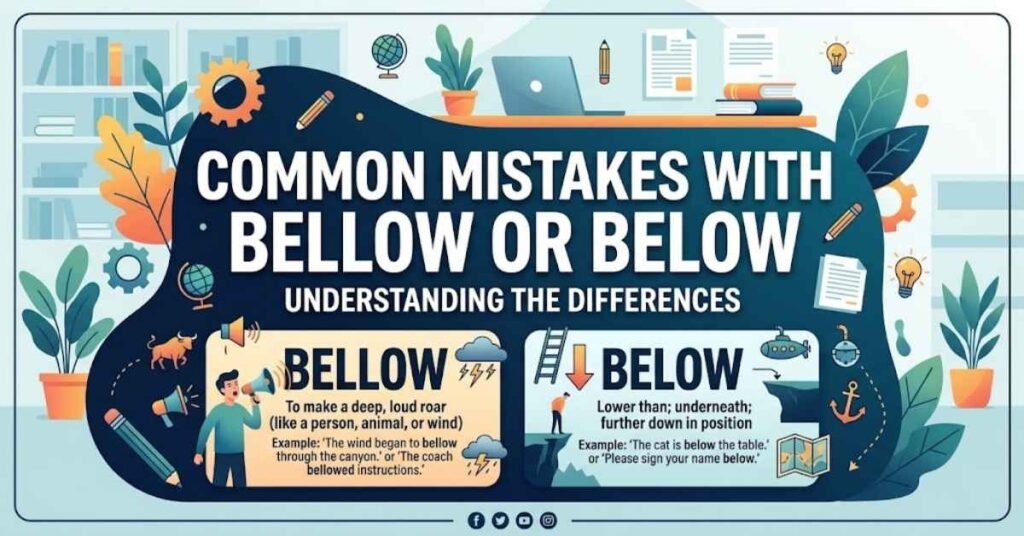
Most errors come from typing fast, not from missing the rules.
Both words are real, so autocorrect stays quiet.
That’s what makes this such a sneaky common spelling error.
Let’s walk through the usual slips and their fixes.
❌ Wrong: “Please see the instructions bellow.”
This one appears in emails and product pages all the time.
The writer means the text underneath, so “bellow” is the wrong pick.
The sentence points to position, which needs below.
Written this way, it sounds like the writer is shouting the steps at you.
✓ Right: “Please see the instructions below.”
Here below does its job.
It’s an adverb that tells the reader where to look.
The same fix works for “details below,” “see below,” and “steps below.”
If it points down the page, it’s below.
❌ Wrong: “The crowd started to below in excitement.”
Now the mistake flips.
The crowd is making noise, so the sentence needs a verb for a loud sound.
Below can’t be a verb at all.
It never takes endings like “-ed” or “-ing,” which gives you a quick check.
✓ Right: “The crowd started to bellow in excitement.”
Bellow works because it’s a verb built for bellowing.
You can also say “the crowd bellowed” or “the crowd was bellowing.”
That answers the bellow past tense question.
The past form is bellowed, as in “he bellowed the command.”
❌ Wrong: “His voice was a low bellow as he read the notes.”
This one is tricky.
The spelling is fine, so the real problem is meaning.
A bellow is loud and big, and the word “low” fights that picture.
If he spoke softly, choose “murmur” or “mumble,” and if he spoke with force, write “a deep bellow.”
❌ Wrong: “Temperatures fell bellow zero.”
Falling temperatures describe a level, not a sound.
So the writer needs below.
Weather posts get this wrong a lot.
Watch for “bellow freezing” and “bellow average” too.
✓ Right: “Temperatures fell below zero.”
Below zero, below freezing, and below average all describe a spot on a scale.
That’s a level, so below wins every time.
The same goes for below expectations.
Whenever you compare a number or a standard, reach for below.
Bellow or Below in Everyday Examples
Real life makes the difference obvious.
Here are scenes you’ll meet at work, at home, and online.
- Email: “The invoice is attached below.”
- Sports: The coach bellowed at the referee after the missed call.
- Farm life: The bull bellows at dawn.
- Weather: It’s below freezing this morning.
- Forms: Sign below the line.
- School: Test scores stayed below expectations.
Picture a manager who sends a team memo that says “deadlines are bellow.”
Half the team laughs, and the other half wonders who’s yelling.
Each example carries either sound or level, never both.
Sort your sentence that way, and the sentence examples in your own writing will fall into place.
Read More: Volumn or Volume: Which Spelling Is Correct? 2026
Bellow or Below – Google Trends & Usage Data
Below is by far the more common word in English.
It shows up in instructions, weather reports, forms, and reviews every single day.
Bellow is rarer, mostly living in fiction and stories about loud voices.
So most searches for the pair come from people checking a possible spelling confusion.
You can see the pattern yourself in Google Trends.
I’m skipping exact numbers, since they shift month to month, but run the Comparison and share what you find in the comments.
Keyword Comparison Table
| Feature | Bellow | Below |
| Part of speech | Verb, noun | Preposition, adverb |
| Core meaning | Loud, deep shout or roar | Lower position, level, or amount |
| Sound or position | Sound | Position |
| Example | The coach bellowed the command. | See the list below. |
| Related words | Roar, shout, yell | Under, beneath, less than |
| Past tense | Bellowed | None |
| Memory clue | Contains bell | Contains low |
| Pronunciation | BEL-oh | bih-LOH |
| UK vs US spelling | Same | Same |
Frequently Asked Questions
Is “bellow” and “below” the same word spelled differently?
No, they’re two different words.
They have different meanings, different origins, and different parts of speech.
They’re easy to confuse because the spelling differs by a couple of letters.
Think of them as similar looking words that live in separate corners of the dictionary.
Can “bellow” ever mean the same thing as “below”?
No.
Bellow deals with loud sound, while below deals with position or level.
They’re not interchangeable words.
Swapping one for the other changes the meaning completely.
Is it “see bellow” or “see below”?
It’s see below.
You’re pointing to text underneath, which is a position.
Writing “see bellow” is one of the most common mistakes in emails.
Fix it once, and your messages instantly look sharper.
What is the past tense of “bellow”?
The past tense is bellowed.
For example, “The captain bellowed the order across the deck.”
The -ing form is bellowing.
Below has no past tense, because it isn’t a verb.
Is “below” ever used as a noun?
Not in careful writing.
You’ll see “the below” in informal notes, but most editors prefer “the text below.”
If you want a safe rule, treat below as a preposition or an adverb.
That covers nearly every sentence you’ll write.
Can animals bellow?
Yes, and they do it often.
Bulls are the classic example, and alligators bellow during mating season too.
People bellow as well, usually when they’re angry or trying to be heard.
The word fits any big, booming voice.
Is “below” used the same way in British and American English?
Yes.
Both varieties spell it the same and use it in the same ways.
The only real difference you might notice is style preference.
Some UK writers lean toward “beneath” in formal pieces, but below is fine everywhere.
Conclusion
Bellow or Below is easy once you know the trick. Below means a lower place, level, or amount. Bellow means a loud, deep shout. Use below for “see below” and “below zero.” Use bellow for a bull or an angry coach. Remember this clue. Bellow has “bell” in it, and below has “low” in it. With this tip, bellow or below won’t confuse you again.
Now it’s your turn. Read your last email or post. Did you write bellow or below correctly? Fix any slips you find. Both words are real, so spellcheck won’t catch them. Writers get bellow or below wrong all the time, so don’t feel bad. Share this guide with a friend who needs it. Got a tricky word pair of your own? Drop it in the comments. We’ll help you sort out the next one.

James Carter is an English grammar writer and contributor at GoldenMegazine.com, where he shares clear, practical, and easy-to-understand guidance on grammar, vocabulary, sentence structure, and everyday English usage. His goal is to make complex language concepts simpler for students, writers, and English learners while helping readers communicate more confidently and effectively.
