
Barrel or Barrell trips up a lot of writers. It looks like a tiny detail. But one wrong letter can make your writing look careless. So which spelling is right? Barrel is correct. It has one L at the end. Barrell is a mistake, unless it is a surname. You may use the word for oil, wine, or even a rifle.
The Barrel or Barrell mix-up is very common. Words like bell and tell end with a double L. Your brain copies that pattern. That is why the extra L sneaks in. Don’t worry, it is easy to fix. In this guide, you will learn the meaning, the origin, and a simple memory trick. You will also see real examples. It takes just a few minutes to read. By the end, you will know Barrel or Barrell without a doubt.
Barrel or Barrell – Quick Answer
Barrel is the right spelling.
It has two Rs in the middle and a single L at the end.
Barrel or Barrell with a double L is a spelling mistake in standard English.
Check any dictionary entry and you won’t find it listed as a variant.
Think of it as a simple test.
If your spell checker underlines it in red, trust the machine this time.
Is Barrell a Real Word?
Not as a common noun.
Barrell doesn’t name anything you’d roll, pour, or shoot.
It does exist as a proper noun.
Barrell is an English family name, and a few places carry it too.
Someone called Tom Barrell spells his name with two Ls on purpose.
So context decides.
Writing about a person with that surname Barrell or Barrell? Keep the double L.
Writing about a cask or a gun part? Drop one L.
Barrel Meaning and Definition
The barrel meaning starts with a cylindrical container that bulges in the middle.
Makers traditionally build it from curved wooden staves bound by metal hoops.
The barrel definition stretched over the centuries.
Today it covers storage vessels, measuring units, weapon parts, and even a way of moving fast.
That range keeps it a common English word.
Few words work this hard.
As a Noun
Barrel as a noun is the version you’ll see most.
It names a wooden barrel, a metal drum, or a unit of volume.
A gun barrel is the tube a bullet travels through.
The barrel of a rifle has spiral grooves inside that spin the bullet for steadier flight.
Brewers and winemakers rely on it too.
A barrel of beer or wine often ages in oak, and the oak shapes the taste.
As a Verb
Barrel as a verb means to move fast, usually a bit recklessly.
A truck barrels down the highway, and a toddler barrels through the kitchen.
It can also mean putting something into casks.
Winemakers barrel their reds once fermentation ends.
Notice that verbs take endings.
That’s exactly where the double L trouble begins.
Read More: Halves or Halfs? The Correct Spelling Explained (2026)
Barrel vs Barrell: Side-by-Side Differences
Here’s the quick contrast.
One is a standard word, and the other is a slip.
These points show the gap clearly:
• Barrel: correct in American English and British English, used as a noun and a verb.
• Barrell: not a standard word, valid only as a surname or place name.
• Barrel: carries full definitions in every major dictionary.
• Barrell: appears only in name directories and misspelling lists.
Pronunciation doesn’t separate them.
Only the page does, which is why the error slips through in writing but never in speech.
Why Do People Misspell Barrel as Barrell?
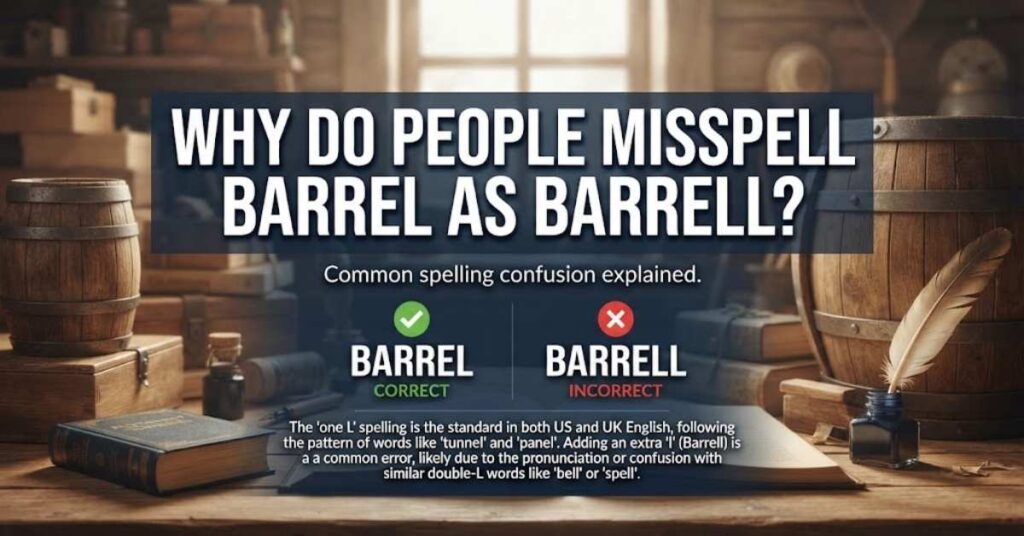
Spelling confusion rarely comes from laziness.
English has a messy double-letter rule, so readers guess.
Three habits cause most of the trouble.
Let’s break them down one by one.
1. The Double-Letter Analogy Trap
Words like bell, tell, shell, and spell all end in a double L.
Your brain spots that pattern and applies it to barrel.
But barrel ends in the syllable rel, not ell.
Compare it with level, model, and travel, where spelling rules keep a single L.
That’s the double L confusion in a nutshell.
2. Confusion with Verb Forms
Some verb forms really do double the L.
British verb forms like barrelled and barrelling carry two Ls.
The double lingers in memory.
Then it leaks back onto the base word, where it doesn’t belong.
3. Typing Speed and Autocorrect
Fast thumbs tap L twice without asking.
These typing mistakes pile up when you’re texting on a phone.
Autocorrect usually catches it.
But it often stays quiet in name fields, code editors, and search bars.
British English vs American English Spelling
The base word stays the same on both sides of the Atlantic.
Barrel is the correct form of barrel in both.
The difference shows up once you add an ending.
British English doubles the final L, while American English keeps one.
These regional spelling differences follow a wider pattern, like travelled and traveled.
Pick one style and stay consistent across your whole document.
Here’s how the verb forms line up:
• American verb forms: barrel, barrels, barreled, barreling
• British verb forms: barrel, barrels, barrelled, barrelling
The Origin of Barrel or Barrell
The etymology of barrel runs back to Middle English barel.
That form borrowed from Anglo-French and Old French baril, a small cask.
Past Old French, the trail goes cold.
Some references point to a Gallo-Romance root, though nobody can prove it. The Online Etymology Dictionary lays out the details.
Here’s the takeaway.
The standard word never settled on a double L.
The extra letter belongs to later verb endings and to the family name.
Which Spelling Should You Use?
Use barrel for the container, the unit, the gun part, and the verb.
Save Barrell for people who carry that last name.
In formal writing, double check before you hit send.
A typo in a report, résumé, or product listing dents your credibility fast.
In informal writing, the stakes drop, but the rule stays put.
A slip in a text is forgivable.
A slip in a headline isn’t.
How to Pronounce Barrel Correctly
Barrel pronunciation is simple.
Say BAIR-ul, with the stress on the first part.
Barrel syllables number two: bar and rel.
The second one is soft, almost swallowed, which is why spelling by ear fails.
Accents vary a little.
Some speakers say BARE-ul and others say BAR-ul, but the spelling never changes.
Barrel in Everyday Examples
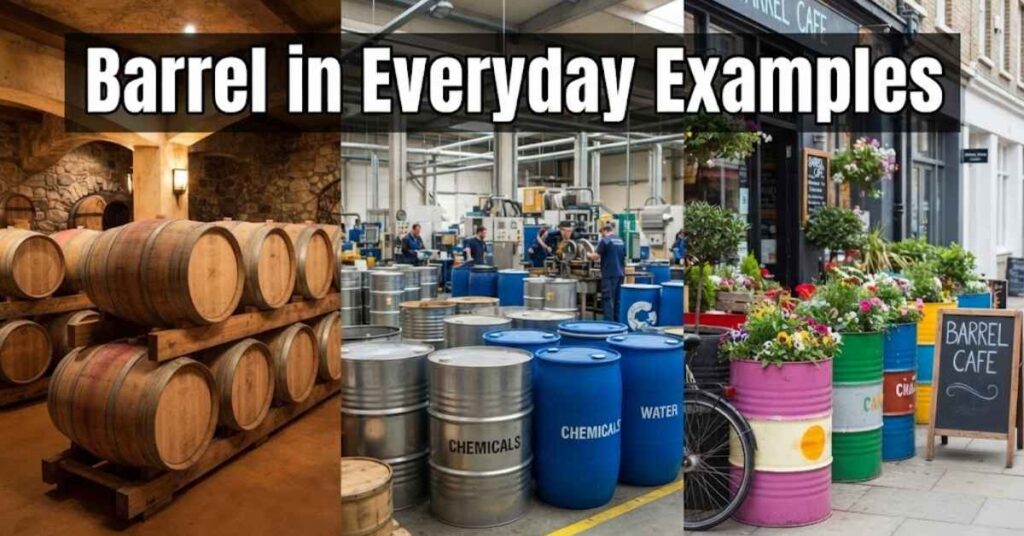
Seeing a word in action helps it stick.
These barrel examples cover the most common situations:
• Container: The winery aged its red in a French oak barrel.
• Unit of measurement: Analysts watched the price per barrel closely.
• Gun part: He cleaned the barrel after the range session.
• Verb: The bus barreled around the corner and nearly clipped us.
• Idiom: The landlord had me over a barrel.
Notice how the meaning shifts while the letters stay put.
Barrel usage is flexible, but the spelling isn’t.
Read More: Happened or Happend? Which Spelling Is Right? Find Out 2026
Barrel in Industry: Oil, Beer, and Wine
A barrel of crude oil is the oil industry’s standard unit.
One barrel equals 42 gallons, or about 159 liters.
The unit dates back to the Pennsylvania oil boom of the 1860s.
Producers shipped crude in wooden barrels, and the name never left.
The barrel brewing industry uses different sizes.
A US beer barrel holds 31 gallons, while the UK standard is 36 imperial gallons.
A classic Bordeaux wine barrel holds roughly 225 liters.
Barrel Idioms and Common Collocations
Common collocations make barrel feel alive.
Four phrases show up again and again:
• Over a barrel meaning: stuck in a weak position while someone else holds the power.
• Lock, stock, and barrel meaning: everything, the whole lot. It comes from the three main parts of an old musket.
• A barrel of laughs: someone or something very funny, often said with sarcasm.
• Scraping the bottom of the barrel: settling for the last and poorest options.
Keep the spelling steady inside each phrase.
Writing “lock, stock, and barrell” looks sloppy.
Barrel of a Gun: Why the Spelling Matters in Technical Writing
Gun writers, hunters, and hobbyists use the word constantly.
A gun barrel shows up in manuals, forum posts, and product pages, so one typo can spread fast.
Specs also pair the word with numbers, like barrel length and twist rate.
A listing that says “20 inch barrell” makes buyers wonder what else the seller got wrong.
Search engines notice too.
Pages with clean spelling tend to earn more trust from readers, and trust keeps people on the page.
Quick Proofreading Checklist Before You Publish
A fast check saves you from a spelling mistake you’ll regret later.
Run through this list before you hit publish:
• Search the draft for “barrell” and fix every match that isn’t a surname.
• Confirm you picked one style, American English or British English, and stuck with it.
• Check verb endings: barreled and barreling for US readers, barrelled and barrelling for UK readers.
• Read idioms aloud, like over a barrel and lock, stock, and barrel, to catch stray letters.
This takes two minutes.
It also works for other tricky words with the same double L confusion.
Memory Trick to Remember the Correct Spelling
Here’s a memory trick that works.
Two Rs, one L.
The R is the busy letter in this word, and the L just closes the door.
Try chunking it too.
Say bar, then rel, and write exactly that.
There’s no room for a second L.
Got a trick of your own?
Drop it in the comments so other readers can steal it.
Read More: Opening or Openning: Stop Making This Common Mistake! (2026)
Barrel – Google Trends & Usage Data
Search data tells a clear story.
Compare the two terms in Google Trends and barrel dwarfs barrell by a wide margin.
Trends shows relative interest, not raw counts, so I won’t quote exact numbers.
The Google Books Ngram Viewer points the same way.
Printed books use barrel far more often, so the usage data backs up the dictionary.
Try it yourself.
Type barrel,barrell into the box and watch the lines split.
Comparison Table: Barrel vs Barrell
| Feature | Barrel | Barrell |
| Status | Standard English word | Misspelling, or a surname |
| Dictionary entry | Yes | No |
| Part of speech | Noun and verb | Proper noun only |
| US verb forms | barreled, barreling | Not applicable |
| UK verb forms | barrelled, barrelling | Not applicable |
| Plural | barrels | the Barrells (a family) |
| Pronunciation | BAIR-ul | Same sound |
| Formal writing | Always correct | Only for the name |
Frequently Asked Questions
Is “barrell” ever correct in English?
Only as a surname or a place name.
In every other case, it’s a misspelling.
What is the plural of barrel?
The barrel plural is barrels.
Just add an S, and skip the apostrophe.
How do you spell barrel in British English?
The noun stays barrel.
The verb forms double the L: barrelled and barrelling.
Does the double “l” rule apply to barrel?
Only when British writers add -ed or -ing.
The base word keeps a single L, so barrell is never right.
What does “over a barrel” mean?
It means you’re in a helpless spot.
Someone else holds the leverage, and you’ve got few choices.
Is barrel a unit of measurement?
Yes.
A barrel of oil equals 42 US gallons, or about 159 liters.
Beer and wine barrels use other sizes.
What part of speech is barrel?
It works as both a noun and a verb.
The noun names a container or a gun part, and the verb means to rush.
Conclusion
So, Barrel or Barrell? The answer is simple. Barrel is the right spelling. It has one L at the end. Barrell is only a surname. Next time you doubt Barrel or Barrell, think of two Rs and one L. That small trick works every time. Say it out loud, then write it down.
The Barrel or Barrell mix-up happens to everyone. Words like bell and tell trick our eyes. British verbs like barrelled add to the mess. But the base word never changes. Always write barrel for oil, wine, or a rifle. Do a quick check before you publish. Spelling gets easier with practice. Keep this page handy. Got your own trick for Barrel or Barrell? Share it in the comments. Send this guide to a friend who needs it. Now you can answer Barrel or Barrell with full confidence.

James Carter is an English grammar writer and contributor at GoldenMegazine.com, where he shares clear, practical, and easy-to-understand guidance on grammar, vocabulary, sentence structure, and everyday English usage. His goal is to make complex language concepts simpler for students, writers, and English learners while helping readers communicate more confidently and effectively.
