
Bellies or Bellys: which spelling is right? Many writers stop and wonder about this. The answer is simple. Bellies is correct, and bellys is a mistake. The word belly ends in a consonant plus y. So you change the y to i and add es. Both forms sound the same, which makes the error easy to miss. Fast typing makes it worse.
This guide explains Bellies or Bellys in plain words. You will learn the plural rule step by step. You will see real examples you can copy. You will also learn the common mistakes to avoid. British and American English use the same spelling, so there is no regional trick. Once you know the rule, Bellies or Bellys will never confuse you again. It takes only a few minutes. You’ll feel sure every time you type. Let’s get started.
Bellies
Bellies is the correct plural of belly.
It’s the correct spelling of bellies you’ll find in every major dictionary.
Use it whenever you mean more than one stomach or rounded underside.
That covers people, animals, and even objects.
Bellys
Bellys isn’t a standard English plural.
It’s an incorrect plural spelling that appears when writers add only the letter s.
You’ll spot it in rushed texts and captions.
Readers notice it fast, though.
Bellies or Bellys – Quick Answer
The short version: bellies is right and bellys is wrong.
The belly plural form follows the change y to ies rule, with no exceptions.
Neither British nor American writers accept bellys.
So you can stop second-guessing yourself.
Still unsure in the moment?
Remember that belly ends in a consonant plus y, and that single detail settles the spelling.
Examples
Here are a few bellies in everyday sentences to see the pattern.
Each one talks about more than one belly.
• The toddlers rubbed their bellies after lunch.
• Two puppy bellies poked out of the blanket.
• Hungry bellies filled the cafeteria by noon.
See how every sentence has a group of people or animals?
That plural meaning is your cue for the ies ending.
Read More: Skis or Skiis? The Spelling Most People Still Get Wrong 2026
Quick Comparison
| Form | Status | Reason |
| Bellies | Correct | Consonant + y becomes ies |
| Bellys | Incorrect | Adds only s and skips the rule |
What Does “Bellies” Mean?
Bellies means more than one belly.
The best-known belly meaning is the front part of the body, the stomach or abdomen.
It also covers animals, like pet bellies and puppy bellies.
Even a baby’s tummy counts, so baby bellies and the human belly both fit.
Objects use the word too.
Think of the belly of a ship or the belly of an airplane, the rounded underside that carries the load.
The Origin of Bellies and the Word Belly
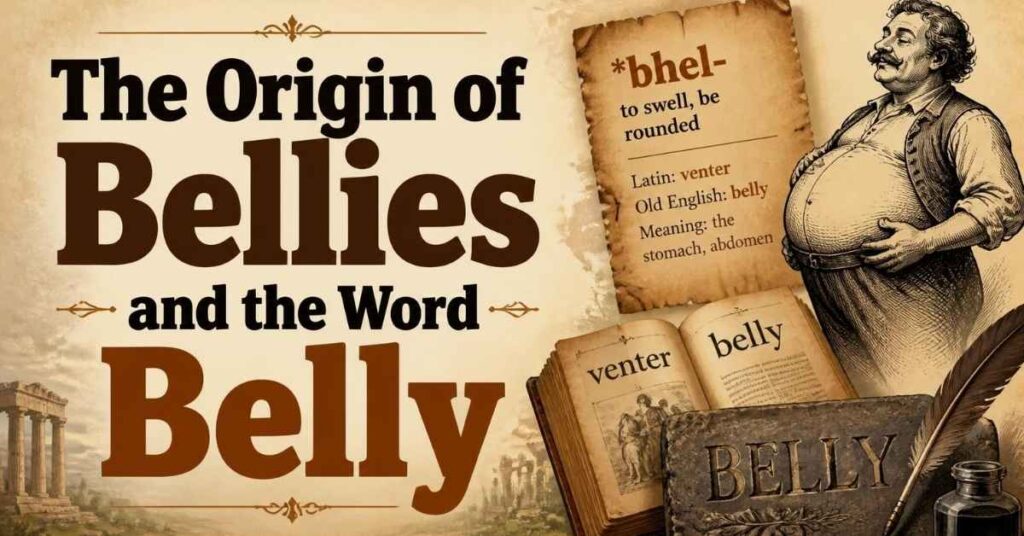
The etymology starts in Old English.
Back then, belg or bælg meant a bag, a pouch, or even a leather bottle.
Spellings like bely showed up in Middle English.
Over time, the meaning settled on the body part, since a stomach looks a lot like a bag.
That bag idea explains the ship and airplane uses.
If you’d like the full word history, Etymonline’s entry on belly lays it out.
British English vs American English Spelling
Good news: there’s no split here.
British and American writers both spell the plural bellies.
Some words really do change across the Atlantic, like colour and color.
Belly isn’t one of them.
Comparison Table: British vs American Usage
| Form | British English | American English |
| Singular noun | belly | belly |
| Plural noun | bellies | bellies |
| Verb (he/she/it) | bellies | bellies |
| Misspelling | bellys | bellys |
Key Point
The y to ies rule belongs to shared English spelling rules.
It doesn’t depend on where you live or which style guide you follow.
So if you’ve seen bellys somewhere, blame a typo.
Don’t blame a dialect.
Which Spelling Should You Use?
Use bellies, whether it’s an email, a school essay, or a post.
That’s the only correct spelling that holds up everywhere.
Readers rarely praise good spelling, but they do notice slips.
One small error can make a whole page feel sloppy.
Professional Advice
If you write for clients, treat bellys as a red flag during proofreading.
Add it to your checklist right next to its and it’s.
When you’re unsure, check a trusted source like Merriam-Webster’s belly entry.
It takes ten seconds and saves you an awkward edit later.
Grammar Rule Behind the Correct Plural
Belly is a singular noun that ends in a consonant (the l) followed by y.
The rule says to drop the letter y and add ies.
That’s why belly becomes bellies, never bellys.
It’s one of the most dependable grammar rules for plurals.
Why “Bellys” Is Incorrect
Writing bellys skips the rule for nouns ending in y.
A consonant sits before that y, so tacking on a lone s breaks the pattern.
Here’s the sneaky part: both spellings sound identical when you say them.
Your ears can’t catch the error, so only your eyes can.
The real pronunciation of bellies ends with a clean ee sound.
The ies spelling matches that sound, which is one more reason it wins.
How to Form Plurals of Words Ending in “Y”
Two simple rules cover almost every case.
Check the letter right before the y, and the answer shows up.
Here’s how the consonant + y plural rule compares with its vowel plus y twin.
The first list changes the ending, while the second just adds an s.
• Consonant + y: baby becomes babies, lady becomes ladies, and city becomes cities.
• Vowel + y: toy becomes toys, day becomes days, and monkey becomes monkeys.
Proper names are the main exception, so it’s the Kennedys, not the Kennedies.
That one check clears up most common spelling mistakes with the letter y.
Why English Changes Y to I Before ES
The switch isn’t random.
A word like bellys would stack a y and an s awkwardly, while bellies keeps the soft ee sound clear.
English settled on this habit long ago, and it stuck across thousands of words.
That’s why pluralization feels so predictable once you know the pattern.
It also helps language learners.
One rule, applied the same way every time, beats memorizing each word by hand.
Common Mistakes with Bellies or Bellys
Most errors come from habit, not carelessness.
Here are the three you’ll meet most often.
Mistake 1: Adding Only “S”
Most plural nouns need just an s, so your brain runs on autopilot.
Dog becomes dogs, so belly becomes bellys, right? Not quite.
The fix is easy.
Look at the letter before the y, and swap in ies if it’s a consonant.
Mistake 2: Confusing Verbs and Nouns
Bellies can also work as a verb, as in “the sail bellies out in the wind.”
Some writers mix that up with the noun and start doubting the spelling.
The spelling stays the same, but the job changes.
Verb conjugation follows the same pattern, so she bellies up to the bar.
Read More: Bellow or Below? Stop Making This Spelling Mistake (2026)
Mistake 3: Assuming Informal Writing Allows Errors
“It’s just a text” is a tempting excuse.
Still, habits from casual writing sneak into work emails.
Typing the correct plural every time keeps the habit clean.
Then you never have to switch modes.
Bellies or Bellys in Everyday Examples
Let’s look at bellies in example sentences across different settings.
The tone changes from place to place, but the spelling never does.
Emails
In professional communication, a typo can look careless, even in a quick reply.
Here’s a line you could actually send:
• Our menu keeps bellies full and guests happy.
News Writing
Newsrooms follow stylebooks and dictionaries, so you’ll see bellies in print.
A headline might read, “Drought leaves bellies empty in several towns.”
Social Media
Bellies in social media posts show up in pet, food, and parenting content.
A caption like “Full bellies, happy hearts” works because it’s spelled right.
Formal Writing
In academic writing, a zoology paper might describe the pale bellies of juvenile birds.
Formal writing leaves zero room for bellys.
Run one last spelling pass before you submit.
Plurals are easy to miss when you’re tired.
Bellies in Idioms and Common Phrases
The word shows up in plenty of sayings.
A fire in the belly means a strong inner drive, and a belly laugh is a deep, hearty one.
• Fire in the belly: intense motivation or ambition.
• Belly laugh: a loud, full-bodied laugh.
• Go belly up: to fail, usually said about a business.
Most idioms stay singular.
When you describe a group, switch to the plural: “They left with full bellies.”
Belly’s, Bellies, and Bellies’: Fixing Apostrophe Slips
Apostrophes cause a second wave of mistakes.
Each form has its own job.
• Belly’s: belongs to one belly, as in “the belly’s soft fur.”
• Bellies: means more than one belly, as in “their bellies were full.”
• Bellies’: belongs to several bellies, as in “the bellies’ round shape.”
The apostrophe never forms a plural.
It only shows ownership.
Bellies in Pet, Parenting, and Health Writing
Most everyday searches for this word come from relatable topics.
Pet owners write about puppy bellies, parents mention baby bellies, and expecting families talk about a pregnancy belly.
Each topic has its own voice.
A vet blog stays factual, while a parenting post can sound warm and playful.
The spelling stays fixed in all of them.
Only the tone shifts, so keep bellies steady and adjust the words around it.
Why Small Spelling Errors Cost You Trust
One typo rarely sinks a page.
Still, it sends a quiet signal about how carefully the writer works.
Google’s guidance on helpful content asks whether a page looks sloppy or hastily produced.
A clean plural won’t rank an article on its own, but errors can chip away at reader trust.
So treat plurals as part of quality control.
Read your draft aloud, then scan every word that ends in ies or ys.
Bellies or Bellys – Google Trends & Usage Data

Curious how often people hunt for this spelling?
Google Trends lets you check in about a minute.
Type bellies and bellys side by side and compare them over the past year.
Expect the correct form to dominate, but see for yourself.
Popularity by Region
Use the region filter to see which countries search most.
Compare the US and the UK, since both use the same spelling.
Any gap you spot usually reflects population size, not different habits.
That fits what the spelling rules already tell us.
Context of Searches
Scroll down to the related queries.
You’ll likely see themes like pets, pregnancy, and food, which match how people actually use the word.
Those themes reveal what readers want.
They need a fast answer plus an example they can copy.
Comparison Table: Bellies vs Bellys
| Feature | Bellies | Bellys |
| Correct plural? | Yes | No |
| Rule followed | Consonant + y becomes ies | Adds only s |
| Singular form | belly | belly |
| Possessive plural | bellies’ | bellys’ (also wrong) |
| Found in dictionaries | Yes | No |
| Safe for work | Yes | No |
Similar Plural Spelling Mistakes in English
Bellies isn’t the only word that trips people up.
These pairs follow the exact same consonant + y pattern:
• Babies, not babys
• Ladies, not ladys
• Puppies, not puppys
• Cities, not citys
• Stories, not storys
• Parties, not partys
• Families, not familys
• Cherries, not cherrys
• Countries, not countrys
A vowel before the y changes everything.
That’s why it’s monkeys, not monkies, and toys, not tois.
Days and dais look alike but aren’t related.
A dais is a raised platform, so it’s a separate word with its own plural.
Read More: Monkeys or Monkies? The Spelling Trick Most People Miss 2026
How to Remember the Correct Spelling of Bellies
Picture the tiny i inside bellies as a belly button.
It sits right in the middle, and you’ll never leave it out again.
• Check the letter before the y every time.
• Pair it with a word you know: baby, babies, belly, bellies.
• Say the rule aloud: consonant plus y becomes ies.
• Proofread plurals once at the end of any draft.
Practice beats memorizing.
Use the quiz below to test yourself.
Quick Practice: Fix These Sentences
Spot the mistake in each line.
Then check your answers underneath.
1. The kittens had round bellys.
2. Their bellys were full after the picnic.
3. She bellys up to the counter every morning.
4. The puppys’ bellies were warm.
Answers: 1) bellies, 2) bellies, 3) bellies, 4) puppies’.
How did you do? Tell us your score in the comments.
Conclusion
So, Bellies or Bellys? Bellies or Bellys has a clear answer. Bellies is the correct spelling. Bellys is a mistake. Both forms sound the same, so the slip is easy to make. The word belly ends in a consonant plus y. So you change the y to i and add es. This rule works in British and American English. It also works for babies, ladies, and cities. That is all you need.
Next time you face Bellies or Bellys, check the letter before the y. If it is a consonant, use ies. Keep the tiny i in mind, like a belly button. Proofread your plurals before you hit send. Now you know the rule behind Bellies or Bellys again. Got a tricky plural of your own? Share it in the comments. Pass this guide to a friend who needs it.
Frequently Asked Questions
Is “bellys” ever correct in English?
As a plural of belly, no.
Standard dictionaries list only bellies.
It can appear as a brand or pet name on purpose.
That’s a creative choice, not a spelling rule.
Why do people often misspell “bellies” as “bellys”?
Most nouns just add s, so the brain goes on autopilot.
Both spellings sound the same, so your ear never objects.
Fast typing makes it worse.
Slow down on plurals and the error fades.
Does British English use a different spelling than American English?
No, both use bellies.
The y to ies rule is shared across British English vs American English.
Real differences show up in words like colour and color.
They don’t touch this one.
What is the rule for pluralizing words ending in “y”?
After a consonant, change the y to ies.
After a vowel, simply add s.
Proper names usually just add s too.
That’s why it’s the Kennedys.
Can “bellies” be used as a verb?
Yes, it’s the third-person form of the verb belly.
For example, “the sail bellies in the wind.”
The verb means to swell or bulge outward.
The past form is bellied, as in “the sails bellied out.”

James Carter is an English grammar writer and contributor at GoldenMegazine.com, where he shares clear, practical, and easy-to-understand guidance on grammar, vocabulary, sentence structure, and everyday English usage. His goal is to make complex language concepts simpler for students, writers, and English learners while helping readers communicate more confidently and effectively.
