
Have you ever received a text saying “ISTG, I didn’t do it” and wondered what the sender meant? The ISTG meaning in text is “I Swear to God.” People use this common internet slang expression to emphasize a statement, show frustration, express surprise, or assure someone they’re telling the truth.
You’ll often see ISTG in text messages, social media comments, DMs, and everyday online conversations. Its meaning can change slightly depending on the situation and the sender’s tone. Sometimes it sounds serious, while other times it adds humor to a casual conversation. Understanding the context helps you interpret the message correctly and reply naturally.
Key Facts About ISTG
- Full form: I Swear to God
- Primary meaning: Emphasizing a statement or expressing strong feelings
- Category: Informal texting abbreviation and internet slang
- Common uses: Frustration, honesty, surprise, excitement, and emphasis
- Where it appears: Text messages, DMs, social media, and online chats
- Formality: Informal, so it usually suits casual conversations
- Religious connection: It contains a reference to God, although people often use it casually.
The meaning of ISTG depends on the surrounding words and the relationship between the sender and receiver. For example, a friend might use it to emphasize a funny complaint, while someone in a serious discussion might use it to reassure you that they’re telling the truth.
What Is ISTG in Text?
ISTG is a short form of “I Swear to God.” It’s one of many texting abbreviations people use to communicate quickly without typing a complete phrase. Instead of writing the entire expression, someone can type three letters and convey a strong emotional message.
You might encounter ISTG in Snapchat messages, Instagram comments, TikTok captions, or private conversations. It fits naturally into casual digital conversations, especially when someone wants to emphasize a point without writing a lengthy explanation.
For example, imagine your friend keeps asking whether you’ve finished your homework. You might reply, “ISTG, I finished it last night!” Here, the abbreviation emphasizes your claim and shows that you’re becoming slightly frustrated with the repeated question.
ISTG Meaning in Text

The central ISTG slang meaning is “I Swear to God,” but people use it in several ways. It can express sincerity, frustration, disbelief, excitement, or a strong reaction to something unexpected.
Consider these common examples:
- To show honesty: “ISTG, I didn’t take your charger.”
- To express frustration: “ISTG, this traffic never moves.”
- To express surprise: “ISTG, you actually won!”
- To show excitement: “ISTG, that was the best concert ever.”
- To make a joke: “ISTG, my cat owns this house.”
In each example, ISTG adds emotional weight to the statement. The sender isn’t necessarily making a literal religious oath. Often, they’re using a familiar phrase to communicate how strongly they feel about something.
The ISTG definition therefore depends on context. When you see it in a message, read the whole sentence before deciding whether the sender sounds angry, playful, surprised, or serious.
Why Do People Use ISTG?
People use ISTG because it adds emphasis without requiring a long explanation. In fast-moving conversations, three letters can communicate frustration, disbelief, or sincerity more quickly than a complete sentence.
Another reason is emotional expression. A plain message such as “I’m telling the truth” can sound neutral, but “ISTG, I’m telling the truth” feels more intense. The abbreviation gives the message a stronger conversational tone, although the exact effect depends on the situation.
Here are the main reasons people use it:
- Strong emphasis: They want someone to take a statement seriously.
- Frustration: They feel annoyed about a repeated problem.
- Surprise: Something happened that they didn’t expect.
- Excitement: They want to highlight a positive experience.
- Humor: They exaggerate a reaction for comedic effect.
- Reassurance: They want someone to believe their explanation.
However, ISTG doesn’t automatically prove that someone is being honest. It’s a way to emphasize a claim, not evidence that the claim is true.
Examples of ISTG in Text
The easiest way to understand ISTG is to see how it works in real conversations. Its meaning changes with the words around it, the situation, and the sender’s emotional tone.
1. ISTG to Show Honesty
Example: “ISTG, I never told anyone your secret.”
Here, the sender wants the other person to believe them. The phrase adds a strong assurance to the statement, particularly if trust has become an issue.
2. ISTG to Express Frustration
Example: “ISTG, if my internet disconnects again, I’m going to lose it.”
The sender sounds annoyed by a repeated problem. In this case, ISTG communicates frustration rather than a literal promise or oath.
3. ISTG to Express Surprise
Example: “ISTG, she remembered my birthday!”
This message shows that the sender feels surprised or impressed. The abbreviation adds emphasis to an unexpected event.
4. ISTG to Express Excitement
Example: “ISTG, that movie was incredible.”
The sender uses ISTG to stress how much they enjoyed the movie. It makes the reaction feel more enthusiastic and personal.
5. ISTG in a Funny Conversation
Example: “ISTG, my dog gets more sleep than I do.”
The sender is probably joking about their dog’s relaxed lifestyle. The expression makes the exaggeration feel more dramatic and entertaining.
6. ISTG in a Serious Conversation
Example: “ISTG, I’m not hiding anything from you.”
This message may appear when someone wants to defend themselves or reassure another person. Depending on the conversation, it might sound sincere, defensive, or slightly impatient.
These ISTG usage and examples show why you shouldn’t interpret the abbreviation in isolation. The surrounding message provides the clues you need.
How to Reply to ISTG

Your reply should match the sender’s meaning and emotional tone. If a friend uses ISTG jokingly, you probably don’t need a serious response. If someone uses it during an argument, a calm answer may work better.
Here are some natural ISTG response examples:
| Situation | Message | Possible reply |
| Honesty | “ISTG, I didn’t do it.” | “Okay, I hear you.” |
| Frustration | “ISTG, this day keeps getting worse.” | “I know, it’s been rough.” |
| Surprise | “ISTG, he actually showed up!” | “No way, seriously?” |
| Excitement | “ISTG, that song is amazing.” | “Right? It’s so good.” |
| Humor | “ISTG, my alarm hates me.” | “Your alarm is your enemy now.” |
| Reassurance | “ISTG, you can trust me.” | “I appreciate you explaining.” |
If you’re unsure how to reply, start by identifying the sender’s intention. Are they joking, defending themselves, sharing excitement, or asking you to believe something?
You don’t need to use ISTG yourself to respond naturally. A straightforward answer often works better, especially when the conversation involves trust, conflict, or sensitive feelings.
ISTG vs. Similar Text Expressions
ISTG belongs to a larger group of popular internet slang terms used in everyday texting. Some expressions communicate honesty, while others show surprise, agreement, or personal opinion.
Understanding the differences helps you choose the right expression for your message.
| Expression | Full form | Common meaning |
| ISTG | I Swear to God | Strong emphasis or assurance |
| FR | For Real | Agreement or emphasis |
| TBH | To Be Honest | Introducing an honest opinion |
| NGL | Not Gonna Lie | Sharing a candid thought |
| OMG | Oh My God | Surprise, excitement, or shock |
| LOL | Laughing Out Loud | Amusement or a lighthearted reaction |
ISTG vs. FR
FR meaning in text is “For Real.” People use it to agree with someone, confirm something, or emphasize that they mean what they say.
For example, “That test was difficult, FR” emphasizes an opinion. By contrast, “ISTG, that test was difficult” adds a stronger sense of emotion or personal emphasis.
ISTG vs. TBH
TBH meaning in text is “To Be Honest.” It’s commonly used before sharing an opinion or personal feeling.
For example, “TBH, I didn’t like the ending” introduces a candid opinion. “ISTG, that ending made me cry” places more emphasis on the speaker’s reaction.
ISTG vs. NGL
NGL meaning in text is “Not Gonna Lie.” People use it when admitting something, offering an honest opinion, or sharing a personal reaction.
For example, “NGL, I was nervous” introduces a confession. “ISTG, I was nervous” makes the feeling sound more emphatic.
ISTG vs. OMG
OMG meaning in text is “Oh My God.” Both expressions reference God, but their usual purposes differ.
OMG commonly expresses shock, surprise, or excitement. ISTG more often emphasizes a claim, expresses frustration, or reassures someone that the sender means what they say.
Is ISTG Formal or Informal?
ISTG is an informal texting abbreviation intended mainly for relaxed communication. You’ll commonly see it among friends, family members, online communities, and people who regularly use social media slang.
It’s generally unsuitable for professional emails, academic papers, formal reports, or official documents. Some readers may find it too casual, while others may dislike the religious wording. In professional settings, clarity and a suitable tone matter more than saving a few keystrokes.
If you need a more appropriate alternative, choose wording that matches your intention:
- Instead of “ISTG, I’m telling the truth,” write “I assure you that I’m being honest.”
- Instead of “ISTG, this deadline is impossible,” write “I’m concerned that this deadline may not be realistic.”
- Instead of “ISTG, I’ll finish it today,” write “I confirm that I’ll complete it today.”
These alternatives preserve your message without relying on casual online language. They also make your meaning easier to understand across different professional and cultural settings.
Can ISTG Sound Rude?
Yes, ISTG can sound rude in certain situations, although the abbreviation itself isn’t automatically insulting. Its effect depends on the words used, the sender’s tone, and the relationship between the people communicating.
For example, “ISTG, you’re not listening to me” may sound angry or confrontational. However, “ISTG, you’re hilarious” can be a friendly compliment, depending on the conversation.
Capitalization and punctuation can also influence how a message feels. A message such as “ISTG!!!” may appear more intense than “istg lol,” although neither format has a fixed meaning.
When interpreting ISTG, consider these clues:
- The surrounding words: Are they friendly, threatening, or frustrated?
- The conversation: Is the sender joking or discussing a serious problem?
- Your relationship: Do you normally communicate casually with this person?
- Emojis: A laughing emoji may suggest humor, while an angry emoji may reinforce irritation.
If the message feels harsh, don’t assume the abbreviation alone explains the sender’s intention. Ask for clarification if necessary.
Is ISTG a Religious Expression?
ISTG stands for “I Swear to God,” so its wording contains an explicit religious reference. In a literal sense, swearing to God can mean calling on God as a witness to the truth of a statement.
However, many people use ISTG as everyday internet slang rather than as a deliberate religious oath. Someone might type it while joking about a television show, complaining about traffic, or emphasizing a surprising event.
That difference matters because not everyone interprets religious language in the same way. Some people use the expression casually, while others may consider it disrespectful or inappropriate.
If you know that someone prefers not to use religious expressions, choose a different phrase. Alternatives such as “I promise,” “Honestly,” or “I really mean it” can communicate emphasis without the same religious wording.
What Does ISTG Mean From a Girl?
The ISTG meaning from a girl is generally the same as it is from anyone else: “I Swear to God.” It doesn’t have a special definition based on gender.
A girl might use ISTG to express frustration, emphasize a statement, show excitement, or joke with a friend. For example, “ISTG, you’re making me laugh so hard” might be playful, while “ISTG, I didn’t say that” could sound defensive.
Don’t assume that using ISTG means she’s angry, flirting, or hiding something. Read the full message and consider your existing conversation before interpreting her intentions.
What Does ISTG Mean From a Guy?
The ISTG meaning from a guy also remains “I Swear to God.” The expression doesn’t change its definition depending on who sends it.
For example, “ISTG, that match was insane” might express excitement about a game. Meanwhile, “ISTG, I’m not lying” may be an attempt to reassure someone or defend a claim.
The best way to interpret ISTG is to focus on context rather than gender. The sender’s wording, previous messages, and relationship with you provide more useful clues than assumptions about how men or women text.
Common Mistakes With ISTG
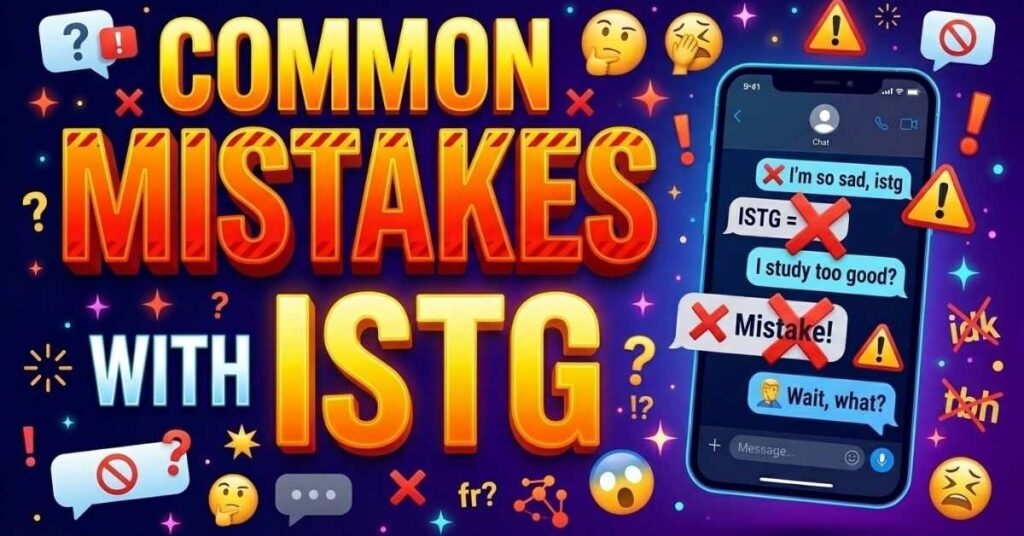
Although ISTG is simple to understand, people sometimes misinterpret its tone or use it in situations where it doesn’t fit.
Here are some common mistakes to avoid:
- Assuming it always means anger: ISTG can express excitement, honesty, surprise, or humor.
- Treating it as proof: Someone who writes ISTG is emphasizing a statement, but the phrase doesn’t establish whether it’s true.
- Using it in formal writing: The abbreviation may seem unprofessional in business or academic communication.
- Ignoring the context: The words around ISTG often determine its emotional meaning.
- Assuming it has a gender-specific meaning: Its basic definition stays the same regardless of who sends it.
- Overlooking its religious wording: Some readers may interpret the expression more literally than others.
- Confusing it with other abbreviations: ISTG, FR, TBH, and NGL serve related but different conversational purposes.
Avoiding these mistakes makes ISTG message interpretation easier. Rather than assigning a fixed emotion to the abbreviation, consider what the complete message communicates.
When Should You Use ISTG?
Use ISTG when you’re communicating casually with someone who understands common texting slang. It can work well when you want to emphasize a statement, react strongly to an event, or express frustration in a familiar conversation.
For example, you might text a close friend, “ISTG, that was the funniest thing I’ve seen all week.” The abbreviation sounds natural because the conversation is relaxed and the meaning is clear.
However, consider your audience before using it. A teacher, employer, customer, or professional contact might prefer clearer language without slang or religious references.
As a simple rule, use ISTG when it fits your relationship and the conversation. If you’re uncertain whether the other person will understand it, write the complete phrase or choose a clearer alternative.
How Is ISTG Written and Pronounced?
People usually write ISTG in uppercase letters, but lowercase “istg” is also common in informal messages. Both forms generally carry the same meaning, and capitalization alone doesn’t create a different definition.
ISTG is an initialism formed from the first letters of “I Swear to God.” People generally say the full phrase aloud rather than pronounce the three letters as a separate word.
You may also see ISTG combined with emojis, repeated letters, or punctuation. For example, “istg 😭” might convey humorous frustration or emotional overwhelm, depending on the conversation. The emoji adds context, but it doesn’t establish one universal interpretation.
FAQs
What does ISTG mean in text?
ISTG means “I Swear to God.” People use it to emphasize a statement, express frustration, or show that they mean what they say.
What does ISTG mean in texting?
In texting, ISTG is an abbreviation for “I Swear to God.” Its meaning depends on the message, which may express honesty, surprise, excitement, or annoyance.
What does ISTG mean from a girl?
It means “I Swear to God,” just as it does when anyone else uses it. The surrounding conversation helps reveal whether she’s joking, frustrated, or being serious.
What does ISTG mean from a guy?
ISTG means “I Swear to God” when a guy uses it. He may be emphasizing a claim, expressing frustration, or reacting strongly to something.
Is ISTG a bad word?
ISTG isn’t generally considered a conventional swear word or an insult, but it contains religious language. Some people may consider it inappropriate because of its reference to God.
Is ISTG rude?
ISTG isn’t inherently rude. It can sound confrontational when used during an argument, but it can also communicate humor, excitement, or friendly emphasis.
What should I reply to ISTG?
Match your reply to the message. You could say “I believe you,” “Seriously?”, “Same here,” or “What happened?” depending on the context.
Is ISTG appropriate for formal writing?
No, ISTG is generally unsuitable for formal writing. Use alternatives such as “I assure you,” “Honestly,” or “I can confirm” when communicating professionally.
Conclusion
ISTG Meaning in Text stands for “I Swear to God.” People use it in texts, social media posts, and online chats. It can show honesty, anger, surprise, or excitement. The exact meaning depends on the message and the situation. For example, someone may use ISTG to prove a point or express frustration. Understanding ISTG Meaning in Text helps you understand what someone really means. It also helps you avoid confusion during casual conversations.
The ISTG Meaning in Text is easy to understand when you look at the full message. Friends often use it in everyday chats. However, it may sound rude or too strong in some situations. Think about your audience before using it. Avoid ISTG in formal emails, school assignments, or professional messages. You can use simple phrases like “I promise” or “Honestly” instead. Now that you know ISTG Meaning in Text, you can recognize this popular slang and use it correctly in your daily conversations.

James Carter is an English grammar writer and contributor at GoldenMegazine.com, where he shares clear, practical, and easy-to-understand guidance on grammar, vocabulary, sentence structure, and everyday English usage. His goal is to make complex language concepts simpler for students, writers, and English learners while helping readers communicate more confidently and effectively.
