
Customize or customise: which one is right? Both are correct. The difference is only about location. Americans and Canadians write customize with a z. People in the UK, Australia and New Zealand write customise with an s. The meaning is the same. It means to change something to fit your needs. You will see both spellings online every day. Neither one is a mistake.
So how do you choose between customize or customise? Think about your readers. Writing for a US audience? Use customize. Writing for a UK audience? Use customise. Then stick with your choice. Mixing both on one page looks careless. Customize or customise is a small detail, but it builds trust. This guide shows the meaning, origin, examples and common mistakes in simple steps. Let’s make the choice easy for you. You will leave with a clear answer.
Customize
Customize is the American spelling, and you’ll see it throughout US English and most Canadian writing.
It uses the -ize suffix, which mirrors how the word sounds.
You’ll spot it in phone menus, browser settings and most SaaS companies based in the States.
A button reading “Customize toolbar” is a classic example.
Customise
Customise is the British spelling used in UK English.
It swaps the z for an s, so the -ise suffix takes over.
Australian English, New Zealand English and South African English follow the same habit.
Together, these regions make up the core of Commonwealth English.
Customize or Customise – Quick Answer
Neither spelling is wrong.
Customize is standard in the US, and customise is standard in the UK.
Your readers decide the winner.
Writing for a Chicago audience? Use customize. Writing for Manchester? Use customise.
Here’s the rule in one line.
Match the spelling to your target audience, and never switch halfway through a project.
Meaning of “Customize/Customise”
To customize means to change something so it fits someone’s specific requirements.
You modify, alter or adapt the original until it suits personal preferences.
It works as a transitive verb, so it needs an object.
You customize a product, a template or a setting.
Related forms follow one steady pattern.
The noun form is customization, the adjective form is customizable, the past tense is customized and the present participle is customizing.
Swap the z for an s and you get the British set.
Examples
Short examples make the rule stick.
These pairs show both spellings in real sentences.
• American: Let shoppers customize a product before checkout. British: Let shoppers customise a product before checkout.
• American: She ordered customized packaging for her candle shop. British: She ordered customised packaging for her candle shop.
• American: Open the menu to customize settings. British: Open the menu to customise settings.
• American: The theme offers customizable colors. British: The theme offers customisable options for colours.
Notice that only one letter changes in each pair.
The meaning stays untouched.
The Origin of Customize / Customise

The story starts with the word custom.
It entered English from Old French coustume, which traces back to the Latin consuetudo, meaning habit or usual practice.
Shops once sold “custom” goods made to a buyer’s own order.
The verb customize grew out of that idea by the mid-1800s, according to Merriam-Webster.
The ending has its own history.
The -ize form came from the Greek -izein, which Latin and French later passed into English.
Read More: Happened or Happend? Which Spelling Is Right? Find Out 2026
British English vs American English Spelling
English spelling differences often come from history, not logic.
This word sits right in the middle of one long-running split.
Noah Webster, an American lexicographer, pushed for simpler spellings in his 1828 dictionary.
That push is why Americans write color and center.
Here’s the twist most people miss.
The Oxford English Dictionary and Oxford University Press prefer -ize, because the Greek root has a z.
Comparison Table
| Word form | American English spelling | British English spelling |
| Verb | customize | customise |
| Past tense | customized | customised |
| Present participle | customizing | customising |
| Noun | customization | customisation |
| Adjective | customizable | customisable |
Why Do Both Spellings Exist?
Two forces shaped the split.
American writers favored spelling conventions that match pronunciation, while many British writers followed French habits.
French verbs ending in -iser nudged UK writers toward -ise.
Over time, each side’s style guide hardened around its own pattern.
Today, the English language has no single referee.
Collins, Cambridge and Merriam-Webster all list both forms.
Which Spelling Should You Use?
The answer depends on who’s reading.
Let’s walk through four common situations.
For American English
Use customize.
The AP Stylebook, the Chicago Manual of Style and Merriam-Webster all point that way.
That covers readers in the US and most of Canada.
Canadian writing keeps -ize, even though it borrows other British habits.
For British English
Use customise for UK readers.
Most British newspapers and brands print it with an s.
Australia, New Zealand and South Africa follow suit.
Local government sites and shops there usually print customise too.
For International Audiences
A global audience makes the choice harder.
Start by checking where most of your traffic comes from.
Open your analytics and rank countries by visits.
The top region wins, and hreflang tags (code that tells Google which language and region a page serves) can cover the rest.
For Business and Marketing Content
Brand credibility rides on small details.
A stray spelling can make a polished brand look careless.
Write a one-page style guide that names your spelling.
It protects brand consistency when freelancers, agencies and digital marketers all touch the copy.
Common Mistakes with Customize / Customise
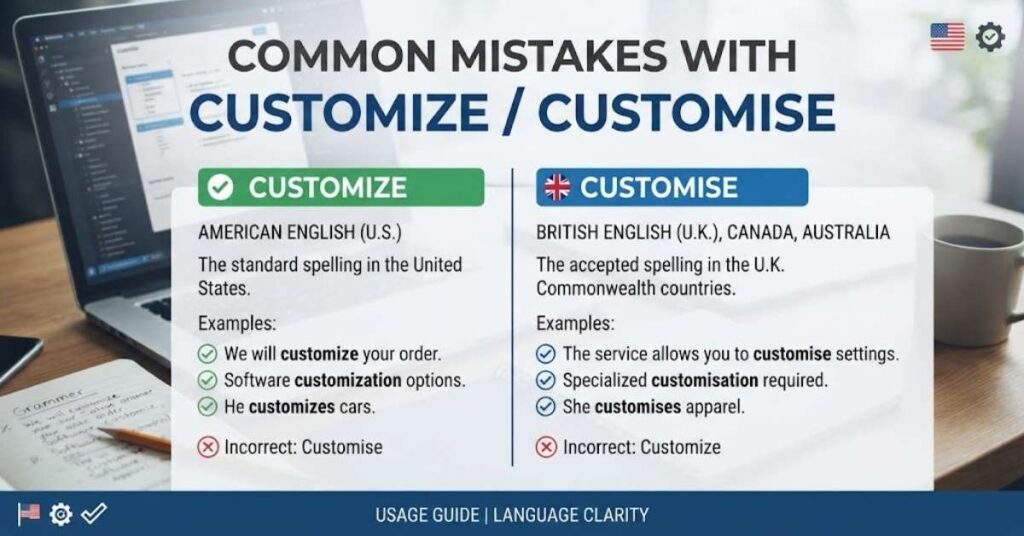
These slips show up everywhere, even on big websites.
The good news is that each one takes minutes to fix.
Mistake 1: Mixing UK and US Spellings
A page might say customise in one line and color in the next.
That mix looks sloppy to readers on both sides.
Run your spell checker with one language variant switched on.
It flags the stray form fast.
Mistake 2: Using Different Spellings on the Same Website
Picture a store with “Customize your mug” on the homepage and “Customise options” at checkout.
Shoppers notice, even when they can’t say why.
That break hurts content consistency and the user experience.
It can also split your keyword signals and weaken SEO performance.
Mistake 3: Confusing “Customize” with “Personalize”
People swap these two as if they mean the same thing.
They don’t, and we’ll unpack the gap shortly.
Customize usually means you make the change.
Personalize often means the system tailors things for you.
Mistake 4: Ignoring Audience Location
A US blog written in British spelling can look off to its core readers.
The reverse is just as true.
Check your top countries in analytics before you publish.
Then pick the spelling that fits them.
Customize / Customise in Everyday Examples

Let’s watch the word at work.
Each setting below has its own tone and needs.
Websites and Apps
Menus love this word.
Think “Customize homepage” in a US app or “Customise layout” on a UK site.
Software interfaces and e-commerce platforms often switch spelling based on the user’s language setting.
If yours doesn’t, ask your developer to add that option.
Emails
Emails get personal fast.
“We customised the plan to fit your budget” reads naturally to a client in London.
Use customized for a client in Texas.
A quick check of the recipient’s country saves an awkward edit.
Social Media
Posts are short, so every letter shows.
“Customize your story highlights” works well for a US brand account.
If followers come from many countries, pick one form and keep it steady.
Consistency matters more than the letter itself.
Business Documents
Contracts, proposals and reports need one spelling from first page to last.
Add it to your style guide and your document templates.
Set the document’s proofing language to match.
That way spell check backs you up instead of fighting you.
Product Descriptions
Shoppers scan these fast.
Whether you write customised or customized packaging, match your store’s region.
Good product descriptions also respect local search queries.
A UK shopper types “customisable options,” so give them exactly that.
Read More: Opening or Openning: Stop Making This Common Mistake! (2026)
Customize vs Personalize: What’s the Difference?
Both words deal with tailoring, but the actor differs.
To customize means the user manually modifies something, like rearranging a dashboard.
To personalize means the system adapts automatically, like a streaming app suggesting shows based on your history.
This is where UX and marketing teams draw the line.
This short list shows the split in action.
Each item pairs a word with a typical example.
• Customize: you choose the colors, layout or fields yourself.
• Personalize: the system picks recommendations or content for you.
Spelling follows the same z-or-s rule here.
Personalization is American, and personalisation is British.
The same goes for product personalization in a store catalog.
Customize or Customise – Google Trends & Usage Data
Search behavior tells a clear story.
Google Trends lets you compare both spellings by country and over time.
The pattern is easy to test yourself.
Customize tends to lead in the US, while customise gains ground in the UK, Australia and New Zealand.
Search Popularity by Country
Try this quick test.
Open Google Trends, type both words, then set the region to the United States and later to the United Kingdom.
Watch the two lines swap places.
That is search popularity by country in action, and it shows how global search results differ from local ones.
Usage in Published Content
Books, news sites and software menus show the same split.
American published content leans toward customize, while British content leans toward customise.
Because technology platforms are mostly US-led, the z form appears across a huge share of the web.
That sheer search volume is why many global tech brands default to it.
Comparison Table: Customize vs Customise
| Feature | Customize | Customise |
| Spelling type | American | British |
| Common regions | US, Canada | UK, Australia, New Zealand, South Africa |
| Suffix | -ize | -ise |
| Noun form | customization | customisation |
| Meaning | Same | Same |
| Pronunciation | Same | Same |
| Backed by | AP, Chicago, Merriam-Webster | Collins and most UK newspapers |
How to Choose the Right Spelling for Your Audience
Follow a simple four-step check.
It takes about five minutes.
1. Open your analytics and find your top countries.
2. Match the spelling to your biggest reader group.
3. Write the choice into your style guide.
4. Set your editor and CMS to that language variant.
Revisit the choice once a year.
Traffic shifts, and your SEO strategy should shift with it.
A Real-World Scenario: One Shop, Two Markets
Picture a small UK shop that sells engraved mugs.
Most buyers live in Britain, but a growing group orders from the US.
The owner keeps customise on the main site.
For the American store view, a separate page uses customize, with an en-US language tag.
Both groups feel at home, and nobody sees a typo.
That small effort supports SEO relevance and builds trust.
Read More: Buoy or Bouy? Which Splling Is Right? Find Out in 2026
Words That Always Use -ise, Whatever Your Region
Not every word follows the z-or-s choice.
Some end in -ise on both sides of the Atlantic.
Examples include advertise, exercise, revise, surprise and comprise.
These words don’t come from the Greek -izein, so Americans keep the s too.
Don’t “correct” them to a z.
A careless spell check might, so read every change.
How to Set Your Spell Checker and Language Tags
Your tools can enforce the spelling for you.
In Word or Google Docs, set the proofing language to English (US), English (UK) or English (Australia).
On the web, add a lang attribute such as en-US or en-GB to your pages.
That tells browsers and search engines which regional English you mean.
Developers can relax a little about code labels.
Most programming languages and APIs use US spellings, so interface text and code labels can differ without trouble.
Frequently Asked Questions
Is “customize” or “customise” correct?
Both are correct.
They’re regional variants of one word.
Choose based on your readers.
Then stay consistent.
Which spelling should I use for SEO?
Use the one your audience searches.
Check search volume by country in Google Trends or a keyword tool.
Google often treats close spelling variants as related, so results can overlap.
Still, matching the searcher’s spelling makes your title and snippet feel familiar.
Is “customise” wrong in American English?
No, it isn’t wrong.
It simply looks British to US readers.
Most US editors will change it.
So use customize for American publications.
Can I use “customize” in the UK?
Yes, you can.
Oxford style uses -ize, and some UK brands and universities follow it.
Just don’t mix it with customise on the same site.
Keep one form from start to finish.
What is the noun form of customize/customise?
The noun is customization in American English.
British writers use customisation.
Both mean the act or result of tailoring something.
For example: “The customization options are wide.”
Is “customizable” or “customisable” correct?
Both work.
Customizable is the American adjective, and customisable is the British one.
They describe things you can change to fit your needs.
A customizable dashboard is a good example.
What’s the difference between customize and personalize?
Customize means you change it yourself.
Personalize means the system tailors it to you.
Think manual versus automatic.
A phone theme you pick is customization, while “recommended for you” is personalization.
Conclusion
Customize or customise: which one is right? Both are correct. The only difference is where you live. Americans and Canadians write the word with a z. People in the UK, Australia and New Zealand use an s. The meaning stays the same. Both spellings mean to change something to fit your needs. You will see each one online every day. Neither one is a mistake.
So how do you pick the right spelling? Think about your readers. Writing for a US audience? Use customize with a z. Writing for a UK audience? Use customise with an s. Then stick with your choice. Mixing both on one page looks careless. It can confuse your readers. This guide shows the meaning, origin, examples and common mistakes. Let’s make the choice easy for you. You will leave with a clear answer. Let’s begin.

James Carter is an English grammar writer and contributor at GoldenMegazine.com, where he shares clear, practical, and easy-to-understand guidance on grammar, vocabulary, sentence structure, and everyday English usage. His goal is to make complex language concepts simpler for students, writers, and English learners while helping readers communicate more confidently and effectively.
