
You’ve typed it a hundred times. And every single time, you pause for a second. Is it kindergarten, or is it kindergarden? You’re not alone here. This is one of those words that trips up even sharp writers, and honestly, it makes sense why.
Let’s settle this once and for all, and along the way, you’ll pick up a few things you probably didn’t know about where this word came from.
Kindergarten or Kindergarden – Quick Answer
Here’s the short version, no waiting around for it. Kindergarten is the correct spelling. Kindergarden is a common misspelling, and you won’t find it listed as standard usage in any major dictionary.
The confusion comes from how the word sounds when you say it out loud. That “ten” at the end can slur into something that sounds like “den,” especially if you’re speaking fast or you grew up hearing it before you ever saw it written down.
So if you’re filling out school enrollment forms, writing a lesson plan, or just texting a friend about your kid’s first day, go with kindergarten. It’s the version every dictionary recognizes, and it’s the one teachers and schools use everywhere.
The Origin of Kindergarten or Kindergarden
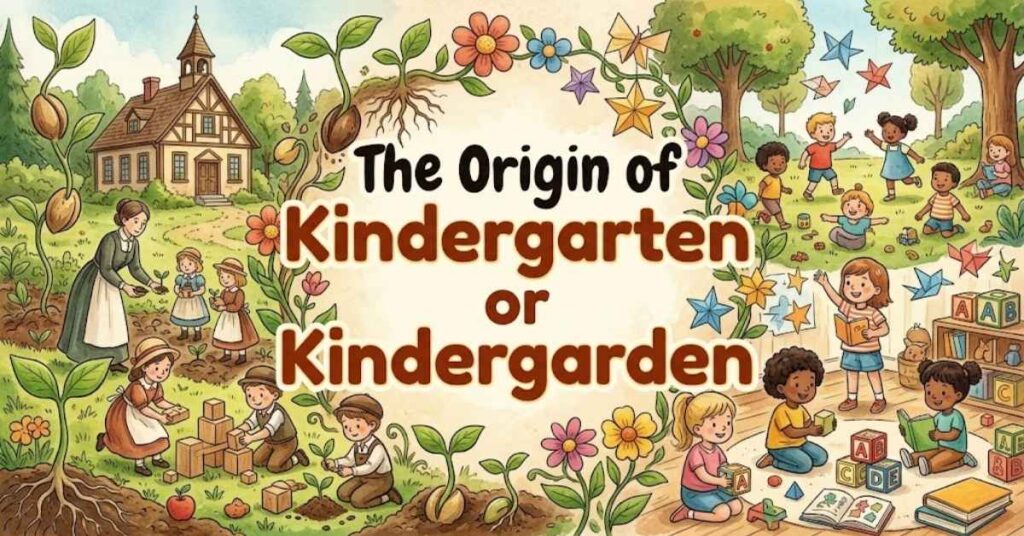
To understand why the spelling is what it is, you have to go back to Germany in the 1830s. A German educator named Friedrich Wilhelm Fröbel coined the term, and he meant it almost literally.
The word is a direct combination of two German word roots: Kinder, meaning children, and Garten, meaning garden. Put them together and you get children’s garden, a place where young kids grow and learn the way plants grow in soil, with care, room to explore, and a little sunlight.
Fröbel wasn’t just naming a building. He was describing a whole philosophy of early childhood education, one built around learning through play rather than rigid instruction. That idea caught on fast, and the word traveled with it. English speakers borrowed the term directly from German without changing the spelling, which is exactly why it still carries that “ten” at the end instead of “den.” There was never a “d” in the original word to begin with.
British English vs American English Spelling
Here’s something that surprises a lot of people: this isn’t a case where American English and British English disagree. Unlike words such as “colour” versus “color” or “centre” versus “center,” kindergarten stays the same on both sides of the Atlantic.
Check the Oxford Dictionary, check Merriam-Webster, check the Cambridge Dictionary, and you’ll see the identical spelling every time. The same holds true for Australian English and Canadian English too. Across all major English variants, there’s no regional split on this one.
That’s actually good news for you. You don’t need to remember a different rule depending on where your reader lives. Whether you’re writing for an American audience, a British one, or anywhere else, kindergarten is the answer. No exceptions, no regional flavor to worry about.
Which Spelling Should You Use?
Use kindergarten. Every time. In formal writing, in informal writing, in academic writing, in text messages to your sister, it doesn’t matter the context. There isn’t a scenario where kindergarden becomes acceptable.
Some folks assume that maybe kindergarden is fine for casual writing, like it’s a shortcut version of the word. It isn’t. It’s simply an incorrect spelling, full stop. Think of it less like a stylistic choice and more like writing “recieve” instead of “receive.” It’s not a variant. It’s just wrong.
If you’re producing teaching materials, filling out school enrollment forms, or writing anything that touches educational content, getting this right matters more than you’d think. A misspelled word on official paperwork can look sloppy, even if the mistake is an easy one to make.
A Simple Trick to Remember the Correct Spelling
Here’s a mnemonic that actually works, and it’s the same one plenty of teachers pass along to their students. Think of the word in two chunks: Kinder and garten. Notice the “t” sitting right there in “garten,” not a “d.”
Another teacher trick that helps: connect it to the word “ten.” Kids in kindergarten are usually around four to six years old, and if you remember that the word ends the same way “often” or “garden” almost does but with a hard “t,” you’ll never second-guess it again.
Try saying it slowly out loud a few times: “kinder-GAR-ten.” Exaggerate that “t” sound. Once your mouth gets used to forming it correctly, your fingers tend to follow along on the keyboard too.
Common Mistakes with Kindergarten
Kindergarden isn’t the only trap here. There’s a whole cluster of related mix-ups worth knowing about, especially if you’re writing anything connected to schools or young learners.
- Kindergartener versus kindergartner: both spellings are actually accepted, though kindergartner shows up more often in American writing.
- Confusing pre-kindergarten (often shortened to Pre-K) with kindergarten itself. They’re related but not the same stage.
- Mixing up preschool and nursery school with kindergarten, when really these describe different age groups and different stages of early childhood education.
- Treating “kindergarten” as a plural form or adding an unnecessary “s” when referring to a single kindergarten classroom.
These aren’t just nitpicks. If you run a blog, manage a school website, or write teaching materials for a living, small slip-ups like these chip away at how polished your content looks. Readers notice, even if they can’t always explain why something feels off.
Kindergarten Pronunciation and Everyday Use
Let’s talk about how to actually say this word, because pronunciation is half the reason the misspelling exists in the first place. The standard way to pronounce it breaks down as “KIN-der-gar-ten,” with a light stress on that first syllable.
Here’s the tricky part. In fast, casual speech, a lot of native speakers naturally soften that final “t” until it sounds almost like a “d.” That’s just how spoken English works, sounds blur together, consonants soften, and nobody’s enunciating like they’re reading a dictionary out loud. But writing isn’t speech. What sounds fine in conversation doesn’t always translate to the page.
A few kindergarten examples in a sentence might help lock this in:
- “My daughter starts kindergarten next fall.”
- “The kindergarten teacher read the class a story about a garden.”
- “Kindergarten readiness looks different for every child.”
Notice how in each case, the word keeps its full “ten” ending. That never changes, no matter how casually you’re speaking or writing.
Kindergarten – Google Trends and Usage Data
Curious how often people actually search for the wrong version? Looking at Google Trends data, “kindergarten” massively outpaces “kindergarden” as a search term, but the misspelled version still pulls in a steady stream of monthly searches. That tells you two things.
First, plenty of people are genuinely unsure and typing the misspelling straight into search engines hoping for an answer. Second, it means there’s real search intent behind that confusion, people aren’t being careless, they’re being honest about not knowing.
This pattern shows up a lot with spelling confusion around borrowed words, especially ones pulled from another language like German. When a word doesn’t follow typical English spelling rule patterns, our brains sometimes fill in the gaps with whatever sounds most familiar. That’s exactly what’s happening here.
Comparison Table – Keyword Variations
| Term | Status | Notes |
| Kindergarten | Correct spelling | Recognized by all major dictionaries |
| Kindergarden | Common misspelling | Not found in standard dictionaries |
| Kindergartner | Accepted variant | Common in American English |
| Kindergartener | Accepted variant | Slightly less common, still valid |
| Pre-K | Related but distinct | Refers to the stage before kindergarten |
| Nursery school | Related but distinct | Typically for younger children |
Why This Word Still Confuses So Many People
It’s worth pausing on why, after all these years, this spelling confusion hasn’t gone away. Part of it is exposure. Kids hear the word constantly before they ever learn to spell it, and by the time they see it written down, the spoken version has already stuck in their heads.
Part of it is also just how English handles borrowed words. We don’t always adjust foreign spellings to match English phonetic patterns, and kindergarten is a perfect example. It kept its German roots fully intact, “t” and all, even though English speakers don’t naturally pronounce it that crisply in casual conversation.
None of this makes the mistake embarrassing. It makes it understandable. Language absorbs words from everywhere, and sometimes the spelling lags a little behind how we actually say things out loud.
Frequently Asked Questions
Is kindergarten spelled with a “d” or a “t”?
It’s spelled with a “t.” The correct spelling is kindergarten, and kindergarden is incorrect.
Why is kindergarten spelled with a t?
Because the word comes directly from German, where Garten means garden and is spelled with a “t,” not a “d.” English kept the original spelling intact.
What age is kindergarten for?
Most kindergarten programs are designed for children aged 4 to 6, though exact age cutoffs vary depending on your school district or country.
Is kindergartner or kindergartener correct?
Both are accepted. Kindergartner tends to be more common in everyday American writing, while kindergartener shows up occasionally too.
Does British English spell it differently?
No. Both British English and American English, along with Australian English and Canadian English, use the identical spelling: kindergarten.
Conclusion
So, next time your fingers hesitate over the keyboard, you’ll know exactly what to do. Go with kindergarten, every time, in every context. It’s the version backed by every major dictionary, it’s the spelling schools and teachers rely on, and it traces straight back to its German word origins without a single letter out of place.
Kindergarden might sound right when you say it fast, but sound and spelling don’t always walk hand in hand in English. Now that you know the story behind the word, that little “t” probably won’t slip your mind again.

James Carter is an English grammar writer and contributor at GoldenMegazine.com, where he shares clear, practical, and easy-to-understand guidance on grammar, vocabulary, sentence structure, and everyday English usage. His goal is to make complex language concepts simpler for students, writers, and English learners while helping readers communicate more confidently and effectively.
